
Proven AMC Clinical Recall Strategies For IMGs (2025 Guide)
Introduction
Staring at a long list of AMC Clinical recalls can feel like reading someone else’s half‑finished notes. Details are missing, stories start in the middle, and nothing seems to connect. Yet for many International Medical Graduates (IMGs), these scattered scenarios decide whether the AMC Clinical Exam is a one‑off hurdle or a repeating source of stress.
Used well, recalls highlight which topics keep returning, how examiners think, and what safe, patient‑centred answers sound like in eight tight minutes. Used badly, they tempt candidates into memorising scripts that fall apart the moment a stem changes one clinical detail.
From our work with thousands of IMGs at LearnMedicine—an AMA‑approved CPD Learning Provider platform—the biggest gap between first‑time passes and repeat attempts is not raw intelligence. It is how early, and how systematically, candidates bring recalls into a study plan grounded in Australian guidelines and clear communication.
This 2025 guide walks through practical, proven AMC clinical recall strategies: what recalls are, common traps, how to build them into a weekly plan, high‑yield topics, and how structured support can make the exam feel manageable.
Key Takeaways
-
Treat recalls as case studies, not scripts, so you build flexible clinical reasoning rather than memorised speeches.
-
Integrate recall practice early and steadily over months instead of cramming in the final weeks.
-
Use every recall to reinforce Australian guidelines, eTG, and college advice, not overseas protocols.
-
Turn recalls into timed role‑play so your history, examination, and counselling flow well under pressure.
-
Study recalls within a guided community or course so you filter errors and stay focused.
What Are AMC Clinical Recalls And Why They Matter For IMGs
AMC Clinical recalls are remembered OSCE stations written by recent candidates—short stems, tasks, and key findings they can recall after the exam. They are not official papers from the Australian Medical Council (AMC), but a large, crowd‑sourced pool of cases that feel very similar to real stations across medicine, surgery, paediatrics, obstetrics, psychiatry, and general practice.
For IMGs, recalls matter because they give an early sense of Australian expectations: the kinds of presentations, the level of detail examiners want, and how ethics and communication are woven into each scenario. At the same time, recalls are incomplete and sometimes inaccurate, so they must sit on top of solid reading, not replace it. At LearnMedicine, we use a solved recall bank reviewed by experienced educators and aligned with current guidelines, so you see the benefits of recall realism without the confusion of raw chat‑group notes.
Understanding The AMC Clinical Exam Structure Through Recalls

The AMC Clinical Exam is a 16‑station OSCE. Fourteen stations are scored, two are rest or pilot, and each active station runs for about eight minutes plus reading time. When you work through many recalls, clear patterns appear: recurring presentations (chest pain in a GP clinic, newborn check on the ward, suicidal patient in ED) and a mix of tasks—focused history, targeted examination, counselling, consent, ethics, and professional behaviour.
Practising recalled stations under timed conditions teaches you how quickly minutes disappear on unfocused questions or long explanations. In our LearnMedicine live classes we use recalls to mirror the real circuit, showing you how to read the stem, set priorities, and hit key scoring points while still sounding like a caring clinician.
The Critical Mistakes IMGs Make When Using Recalls (And How To Avoid Them)
Recalls can raise or drop your score depending on how you use them. These common mistakes are worth avoiding:
-
Memorising scripts instead of concepts. AMC often changes details; focus on the principle, differential, and reasoning, not the exact words.
-
Starting recalls only near exam day. A late rush through hundreds of stations builds panic; steady work over months builds patterns and calm.
-
Trusting every chat‑group recall. Many are incomplete or wrong; always cross‑check key steps against eTG and other Australian guidelines.
-
Using overseas protocols. Excellent non‑Australian management still scores poorly, so rebuild your habits around local guidelines.
-
Reading silently instead of role‑playing. The exam scores spoken performance; act out recalls with timing, structure, and empathy.
-
Underestimating professionalism and ethics. Use recalls with angry relatives, consent issues, or self‑harm to practise boundaries and shared decisions.
At LearnMedicine, we teach a guideline‑based, concept‑first approach with repeated role‑play and real‑time correction of non‑Australian habits.
Building Your Strategic Framework: How To Integrate Recalls Into Your Study Plan
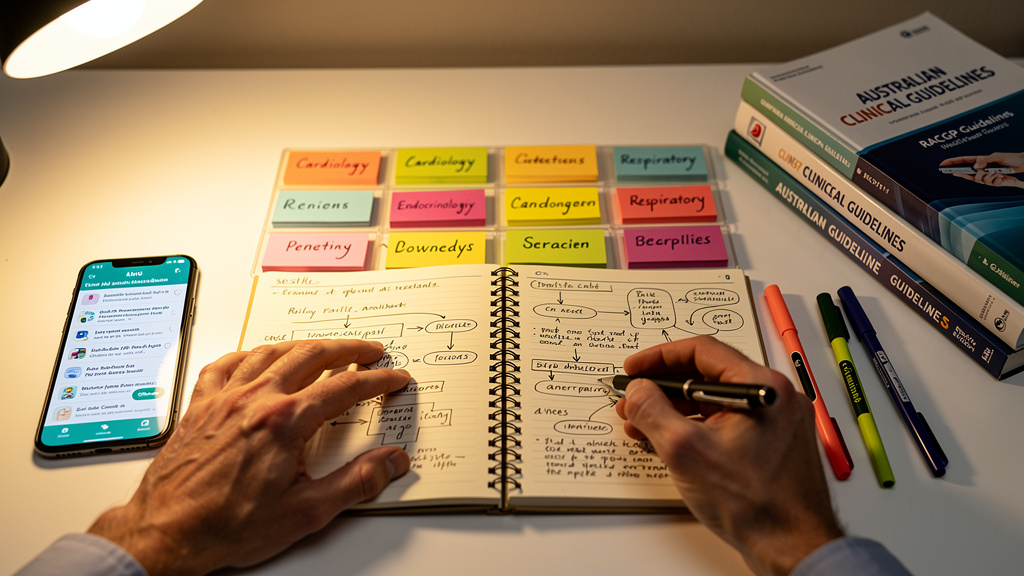
Recalls work best inside a clear study framework, not as random screenshots on your phone. Bring them in from the first week of serious preparation, but in modest numbers—around 15–20 recalls spread across the week.
A simple weekly mix many IMGs like is:
-
40% on core reading (Murtagh, Talley & O’Connor, guidelines)
-
30% on recall analysis and role‑play
-
20% on mock stations or circuits
-
10% on reviewing feedback and short group discussions
Rotate by specialty so each recall rests on fresh theory from the same field, and track stations in a simple spreadsheet by specialty, task type, and confidence rating. Patterns in your weaker areas will appear quickly. LearnMedicine’s All Access Membership is built around this structure, combining courses, recall banks, mocks, and a moderated Telegram community in one organised plan.
Deconstructing Clinical Recalls From Raw Data To High Yield Learning Tools
Many recalls look messy—half sentences, missing vitals, unclear tasks. A quick, repeated method turns each rough note into a high‑yield case:
-
Define the setting and problem. Where are you (GP, ED, ward) and what is the main complaint?
-
Clarify the task. Are you meant to take a history, examine, explain, obtain consent, or manage risk?
-
List known and missing data. Note vitals, findings, results, and the gaps your questions must fill.
-
Spot communication challenges. Anticipate anger, fear, low health literacy, or family pressure.
-
Map your reasoning. Build likely and serious differentials, red flags, and first steps that match Australian practice.
Ask what the station is really testing—postpartum headache, for example, may be about detecting readmission for pre‑eclampsia. Create small variations in age, comorbidities, or setting to train flexible thinking.
Link every recall to eTG, RACGP, or college guidelines, and keep a personal set of 50–75 high‑yield recalls with short notes. Tag them by specialty and task so you can revise, for example, all consent or self‑harm stations together. LearnMedicine models this deconstruction method in our recall modules and live classes.
Sourcing And Evaluating Quality AMC Clinical Recall Resources
Your performance depends heavily on the quality of the recalls you study. Most IMGs first meet recalls in Facebook or Telegram groups, where cases appear quickly but information is raw and often conflicting.
Structured courses and curated recall banks rebuild those fragments into full stations with clear stems, tasks, and model answers linked to Australian guidelines. Signs of quality include realistic OSCE wording, step‑by‑step reasoning, explicit attention to communication and ethics, and visible updates when practice changes.
Be cautious of very short Q&A lists without context, advice that clashes with eTG or RACGP material, or big gaps in specialty coverage. Whatever source you use, confirm drug doses, investigations, and pathways in trusted Australian references. LearnMedicine provides an AMC‑accredited CPD Home platform with an educator‑reviewed recall bank so IMGs can study with confidence rather than guesswork.
Top 10 High Yield Clinical Recall Topics For 2025
1. LearnMedicine’s Comprehensive AMC Clinical Preparation Resources
LearnMedicine’s All Access Membership gives IMGs structured access to AMC Clinical and PESCI courses, recall‑based live sessions, and a moderated lifetime Telegram community, plus practical support with CVs, cover letters, and career planning.
2. Mental Health Risk Assessment And Suicide Risk Evaluation
Mental‑health recalls in GP and ED often require clear questions about suicidal thoughts, plans, intent, means, and protective factors, plus knowledge of when Australian law supports involuntary care or crisis‑team involvement.
3. Breaking Bad News And Serious Diagnosis Disclosure
Breaking‑bad‑news stations span oncology, obstetrics, paediatrics, and general medicine. Frameworks like SPIKES help, but examiners mainly want empathy, checking understanding, cultural sensitivity, and clear follow‑up options.
4. Informed Consent For Procedures And Interventions
Consent recalls ask you to explain indications, steps, benefits, common and serious risks, and alternatives for procedures such as endoscopy, laparoscopy, or amniocentesis, while addressing recovery, follow‑up, and capacity.
5. Paediatric Developmental Assessment And Newborn Examination
Child‑health recalls frequently cover developmental checks, red flags, newborn examination, and the National Immunisation Program Schedule, combining structured assessment with reassurance and realistic referral or follow‑up plans.
6. Obstetric Emergencies And High Risk Pregnancy Counselling
Expect obstetric recalls on pre‑eclampsia, antepartum haemorrhage, preterm labour, and gestational diabetes, testing your recognition of red flags, safe escalation, and calm counselling about monitoring and postpartum care.
7. Chronic Disease Management And Lifestyle Counselling
Chronic‑disease stations on diabetes, hypertension, coronary disease, and COPD assess long‑term planning using eTG targets, appropriate monitoring, care plans, allied‑health referrals, and non‑judgemental lifestyle counselling.
8. Acute Presentation Assessment Chest Pain Abdominal Pain Shortness Of Breath
Undifferentiated presentations—chest pain, abdominal pain, shortness of breath, acute confusion—reward a rapid but systematic approach that identifies red flags, starts safe initial investigations, and decides on observation, admission, or urgent senior help.
9. Medication Review And Adverse Effect Management
Polypharmacy recalls, especially in older patients, require a full medication history (including over‑the‑counter and herbal products), spotting harmful combinations, and explaining deprescribing plans clearly.
10. Ethical Dilemmas And Professional Boundaries
Ethics and professionalism cases often involve confidentiality breaches, inappropriate certificate requests, impaired colleagues, or social‑media problems; anchor your answer in Australian Medical Council and AHPRA codes and state when you would seek senior advice.
Mastering Communication Skills Through Recall Based Practice

Many IMGs who are clinically strong still fall below the pass mark because their communication does not match AMC expectations. Recalls provide dozens of chances to rehearse the exact conversations examiners score highly—angry relatives, frightened parents, low health literacy, and cross‑cultural misunderstandings.
“Communication is not a soft add‑on; it is the main clinical skill,” as one experienced OSCE examiner often reminds candidates.
When you role‑play recalls, use plain language, short explanations, and a chunk‑and‑check style: explain a little, pause, and ask what the patient has understood. Watch your non‑verbal cues and always seek consent before examination. When language or culture may be a barrier, mention professional interpreter use. In LearnMedicine sessions we pause recall scenarios to refine wording so your clinical knowledge is matched by confident, compassionate communication.
Linking Recalls To Australian Clinical Guidelines And eTG

Passing candidates do not just “know medicine”; they know Australian practice. Many IMGs lose marks because their management reflects excellent but non‑Australian habits. Recalls are the bridge between clinical ideas and local standards.
Key resources include Therapeutic Guidelines (eTG), NHMRC documents, the RACGP Red Book, and college guidelines from RANZCOG, RACP, RACS and others, with the RACGP Historical timeline showing the evolution of general practice standards in Australia. Use each recall to confirm drug choices, screening ages, cardiovascular‑risk thresholds, and mental‑health pathways against these sources.
Treat common recall themes—UTI, community pneumonia, antenatal care, suicide risk, chronic‑disease reviews—as prompts to rewrite your internal reference list around Australian norms. Always check publication dates so you are not relying on advice that has changed. In LearnMedicine sessions we show exactly where each management step appears in guidelines, so you practise reading and applying them rather than memorising a single model answer.
The Essential Role Of Mock Examinations In Recall Mastery
Full mock exams are the stress test for your recall work. Short role‑plays cannot reproduce the fatigue and nerves of moving through 16 stations in one circuit.
Plan your first full mock once you have covered the core specialties and practised a solid number of recalls. Good mocks mirror the AMC format: mixed station types, strict timing, trained role‑players, and examiners using AMC‑style criteria.
Use feedback to pinpoint weak station types—consent, development, ethics, acute presentations—and return to those recall categories with focus. Each circuit then becomes a cycle: recalls feed performance; performance tells you which recalls to revisit. LearnMedicine includes formal mock circuits plus feedback workshops, so mocks sit inside your overall plan, not just as a last‑minute test.
Using Community Learning And Peer Support
Preparing for the AMC Clinical Exam can feel isolating, especially when you are working or settling into a new country. Studying recalls with others turns that stress into shared effort and faster learning.
Group role‑play lets you hear different ways to open a consult, explain risk, or structure safety‑netting. Teaching a recall to peers quickly exposes where your understanding is strong and where it is thin. Community spaces also support motivation—seeing others pass makes success feel possible.
Unstructured groups, however, can drift into speculation or misinformation. Agree on ground rules: set a time limit, define learning goals for each session, and settle disagreements by checking guidelines rather than whoever sounds most confident. LearnMedicine’s lifetime Telegram community follows this model, with educator moderation and alignment to course content, so shared recall discussion stays supportive and clinically safe.
Beyond The Exam: How Recall Mastery Benefits Your Medical Career
Although passing the AMC Clinical Exam is the immediate target, the habits you build through thoughtful recall work shape your whole medical career in Australia.
Breaking down stations trains you to take systematic histories, think in focused differentials, and plan safe, guideline‑based management—exactly what you need on ward rounds, in general practice, and in PESCI interviews. The communication practice you gain while explaining risk, negotiating plans, and breaking bad news prepares you for real patients who are scared, angry, or overwhelmed.
Tying recalls to Medicare items, PBS, shared‑care arrangements, and My Health Record makes the Australian system feel familiar before you start work. Repeatedly spotting gaps and closing them with guidelines also rehearses the self‑directed learning every doctor needs. At LearnMedicine, this continues beyond exam prep through structured career guidance, CPD modules, and ongoing community support.
Conclusion
AMC Clinical recalls are powerful study tools, but only when you use them wisely. Treated as scripts, they offer shaky comfort that collapses the moment a station changes. Treated as realistic case studies linked to Australian guidelines, they become one of the strongest supports an IMG can have.
Success with recalls rests on a few consistent habits: start early, work steadily, focus on concepts and reasoning, practise through role‑play, sit realistic mocks, and keep communication and professionalism at the centre of every station. Many IMGs pass each year while juggling work and family; the difference is rarely intelligence, but organised, guideline‑aligned preparation.
Pick one small action from this guide to start today—setting up a recall log, organising a weekly role‑play session, or booking a mock exam. With LearnMedicine’s AMC‑accredited CPD Home platform, recall‑based courses, live sessions, and lifetime Telegram community, you do not have to assemble your preparation alone.
FAQs
Question 1: How Many Clinical Recalls Should I Review Before Feeling Adequately Prepared For The AMC Clinical Exam
There is no magic number. Many strong candidates actively analyse and role‑play around 200–300 recalls, but depth matters more than count. After roughly 150 stations, patterns become clear. The key is whether you can find the main concept, build a safe differential, apply Australian guidelines, and communicate clearly. LearnMedicine’s curated recall bank is organised around this focus on quality, not quantity.
Question 2: Is It Legal And Ethical To Use Clinical Exam Recalls For AMC Preparation
Yes. Using recalls for AMC preparation is legal and common among IMGs. Candidates discuss themes and clinical problems, and the Council regularly changes stems, so copying answers does not work. Ethical use means treating recalls as learning tools, never sharing patient identifiers, and not claiming a station will repeat unchanged. At LearnMedicine, all recall material is de‑identified and used solely for education.
Question 3: How Do I Know If The Recalls I Am Studying Are Accurate And Up To Date With Current Australian Clinical Guidelines
Always assume recalls are incomplete. Use them as prompts, then confirm diagnoses and management in eTG, NHMRC documents, RACGP material, or college guidelines. Be cautious if a recall suggests outdated drugs, odd screening ages, or pathways that clash with those sources. Providers like LearnMedicine have educators who review and update recall banks, but your own habit of checking guidelines remains essential.
Question 4: Should I Focus More On Recalls From Recent Exams Or Is There Value In Older Recalled Content
Both recent and older recalls have value. Newer cases (roughly the last 12–18 months) show the current exam style. Older recalls still teach stable themes—consent, suicide risk, chronic‑disease reviews, antenatal care and more. If you study only new recalls, you may miss these staples. Looking across several years shows which concepts examiners return to repeatedly.
Question 5: How Should I Balance Recall Practice With Studying Standard Medical Textbooks And Attending Preparation Courses
Think of recalls as the application layer, not the foundation. A practical split for many IMGs is: about 40% of time on core reading (Murtagh, Talley & O’Connor, eTG), 30% on recall analysis and role‑play, 20% on mock stations, and the rest on feedback and quick reviews. Build basic knowledge of a specialty before focusing heavily on its recalls. LearnMedicine courses are structured around this balance.
Question 6: What Should I Do If I Encounter A Recall Topic I Have Never Seen Or Studied Before During My Preparation
An unfamiliar recall is a gift—it shows you a gap before the real exam. Look up the condition’s key features and red flags, then confirm local management in Australian guidelines. Add it to a short “gap list” you review each week until everything on it feels comfortable. If a topic still confuses you, raise it with a mentor, study group, or in LearnMedicine’s live classes or Telegram community.


 Google