
Introduction
Choosing the best AMC Clinical exam prep course can feel a lot like choosing the right hospital for a loved one. The stakes are high, options look similar from a distance, and the wrong choice can cost time, money, and a real chance at practising in Australia. For International Medical Graduates (IMGs), the AMC Clinical Exam sits between years of training and the goal of safe, independent practice.
The pass rate is not generous, and the exam tests far more than memory. It looks at how a doctor thinks, speaks, examines, and manages real patients in an Australian setting. This is why serious IMGs do not treat preparation as a side task. A structured course with realistic role plays, mock exams, and focused feedback has become standard practice rather than a luxury.
By 2026, there will likely be more AMC prep providers than ever, each presenting itself as the best choice. Some focus on intensive short bursts, others on long, methodical programs, and many now work fully online or in hybrid models. In this guide, we walk through ten of the strongest options and explain how they differ in content, format, support, and value.
As many AMC examiners put it, “We are not just testing what you know; we are testing how safely you use what you know with patients.”
By the end, the goal is for every reader to match personal needs with the right course. We look at curriculum depth, tutor experience, recall-based teaching, mock exams, PESCI and career support, CPD hours, and real flexibility for working doctors. We also explain why, in our view, LearnMedicine stands out as one of the most complete, IMG‑focused pathways to both the AMC Clinical exam and Australian medical practice.
Key Takeaways
LearnMedicine offers Australian-aligned content, more than five hundred hours of recall-focused video teaching, and at least four live role play classes every week, which together make it a strong candidate for anyone searching for the best AMC Clinical exam prep course.
The right course must fit exam date, budget, and learning style, whether that is a long structured program, an intensive final review, or a flexible online path for doctors who are still working.
Formal mock exams with realistic stations and written feedback are one of the strongest predictors of success because they show exactly where performance drops under exam pressure.
Hybrid formats that blend online teaching with short face‑to‑face workshops often provide a sweet spot, keeping travel demands low while still allowing real physical examination practice.
Courses that include PESCI preparation, CV and cover letter review, interview coaching, and job search guidance give far more long‑term value than exam‑only programs, especially when they also provide CPD hours for GPs.
1. LearnMedicine AMC Clinical Course
When we designed the LearnMedicine AMC Clinical Course, we started from one simple question: what would we want if we were IMGs sitting this exam in 2026 and trying to build a real career in Australia, not just pass one test? That thinking shaped every part of the program.
The course centres on a comprehensive digital library that covers both AMC Clinical and PESCI in a single membership. Members gain access to more than five hundred hours of focused video teaching, built around high‑yield cases and aligned with Australian guidelines. Each case walks through:
Key history points
Focused examination steps
Priority investigations
Clear management plans
This turns performance into a systematic process rather than guesswork.
Live learning sits at the heart of LearnMedicine. We run at least four interactive role play and case discussion classes every week at 6 p.m. Melbourne and Sydney time, on Monday, Tuesday, Thursday, and Friday. Sessions are led by experienced clinicians who know the AMC pathway first hand. During each class, doctors:
Practise full stations
Receive structured feedback
Hear how examiners think and score
These sessions are a defining feature for anyone considering the best AMC Clinical exam prep course.
Because many IMGs are working or caring for families, the course is fully online and self‑paced. Members can watch recordings at any time, repeat cases, and join live classes when their schedule allows. Every course is AMA CPD Home approved, so GPs and other practitioners earn around fifteen to twenty‑five CPD hours while they study.
We also know that passing the exam is only one step, which is why platforms like LearnMedicine have emerged to support IMGs through the entire journey. LearnMedicine provides guidance on AHPRA requirements, supervision levels, and state recruitment rounds. We review CVs and cover letters to Australian standards and share strategies for finding clinics and hospitals that welcome IMGs. Our Telegram community stays open even after exam success, giving long‑term peer support and a network of colleagues across Australia.
2. Medical Training Australia (MTA)

Medical Training Australia (MTA) offers a strong face‑to‑face option, built around a dedicated training facility in Melbourne. Their programs follow a structured timetable, often eight to twelve weeks long, which suits IMGs who want a classroom routine with clear weekly goals and regular contact with tutors.
A clear strength of MTA is physical examination teaching. Using proper clinical rooms and equipment, they guide students through system‑based examinations with repeated hands‑on practice. For many candidates, this direct supervision makes it easier to tidy technique and improve station timing.
MTA uses an experienced tutor group that includes local doctors and IMGs who have passed the exam. They provide feedback during role plays and often run at least one formal mock exam near the end of the course. This gives a realistic test of readiness, although availability of multiple mocks can vary by intake.
The face‑to‑face focus means interstate or overseas doctors must plan travel, accommodation, and time away from family or work. For those who can commit to being in Melbourne, the value lies in immersion and daily contact with classmates. MTA suits IMGs who prefer learning in person, want extended preparation, and can build life around a fixed timetable for several weeks.
3. AMC Online
AMC Online offers a fully digital path, appealing to IMGs who live far from major Australian cities or who want to prepare before even arriving in the country. Their platform provides recorded lectures, case‑based videos, and written resources that can usually be accessed over a set subscription period.
Teaching of physical examinations and communication skills takes place through video demonstrations and live virtual classes. When done well, this format can still deliver clear step‑by‑step instruction, though it demands that students practise with friends or peers to add the real‑life element. For motivated learners who already have solid clinical basics, this can still form a strong AMC Clinical prep course.
Interactive elements are essential in any online model. AMC Online typically schedules live webinars, Q&A segments, and group discussions. Mock exams are run through virtual stations with examiners watching on camera and then providing feedback. While not the same as moving through a physical exam hall, this still trains timing and structured speaking.
The main advantages are convenience and usually lower overall cost. Doctors can study at their own pace, avoid travel, and keep working. The main limits are less hands‑on physical practice and the need to self‑organise role plays outside formal sessions. AMC Online suits self‑directed learners who are comfortable with technology, prefer flexible study hours, and want a more budget‑friendly way to prepare.
4. OzMosis Medical Education
OzMosis Medical Education has been active in the AMC preparation space for many years, and many IMGs know the name from peer recommendations. Their teaching approach blends structured theory sessions with a strong focus on repeated practice of exam‑style stations.
OzMosis usually offers a mix of intensive and comprehensive courses. Intensive options may run for around two weeks, with long daily sessions focused on recall‑based cases and station performance. Longer programs extend over several weeks and cover the full exam blueprint in more depth, including medicine, surgery, psychiatry, paediatrics, and obstetrics.
Their tutors are often IMGs who have passed AMC Clinical and now work in Australia. This background helps them share not only exam strategy but also day‑to‑day expectations in Australian clinics and hospitals. Role plays are central, and most courses include at least one mock exam with written and verbal feedback.
Many students appreciate the course guidebooks and access to online material after class hours. OzMosis also pays close attention to recent exam recalls, which is important in any contender for the best AMC Clinical exam prep course. Pricing reflects the teaching hours and duration, so candidates need to weigh cost against how much contact time they want.
OzMosis suits IMGs who like a clear structure, value teachers who have walked the same path, and want a balance of online resources with practical teaching and mock stations.
5. GPEX (General Practice Education and Training)
GPEX focuses on training for general practice and primary care, which gives their courses a slightly different angle compared with pure exam providers. For IMGs who know that general practice is their long‑term goal, this alignment can be very helpful.
Their curriculum leans strongly toward scenarios seen in Australian general practice, such as chronic disease management, mental health consultations, preventive care, and common procedures. This content supports both AMC Clinical stations and PESCI requirements because PESCI panels often explore how a doctor would work in a community clinic.
GPEX usually offers structured programs that may include workshops, online modules, and sometimes targeted AMC‑related sessions. The strength lies in understanding the GP pathway, Medical Board expectations, and the realities of working in rural and regional settings.
Mock exams may not match the intensity of a dedicated AMC Clinical prep course, yet case‑based practice and feedback still help build exam skills. Many of their offerings are CPD accredited, which makes them attractive for doctors who are already working as GPs in limited or provisional roles.
GPEX suits IMGs who are committed to a general practice career, want strong grounding in primary care standards, and need CPD hours alongside exam and PESCI preparation.
6. Sydney Medical Skills
Sydney Medical Skills takes a very practical approach, built around workshop‑style teaching in a dedicated Sydney facility. Rather than running only long AMC Clinical courses, they concentrate on key hands‑on skills that matter both in exams and in real practice.
Their workshops often cover IV cannulation, suturing, local anaesthetic techniques, skin biopsy, fracture management, and ECG interpretation. These sessions use real equipment and manikins, which builds muscle memory and confidence. For IMGs who feel unsure about procedural skills, this can make a big difference before physical or emergency‑oriented stations.
Some programs at Sydney Medical Skills also look at targeted clinical scenarios, communication, and examination skills, though they may not cover the full breadth of the AMC blueprint. Many doctors therefore use these workshops to supplement another main AMC Clinical exam prep course.
Many of their sessions carry CPD accreditation, which appeals to GPs and hospital doctors who want to keep meeting professional requirements while improving skills. Pricing is usually per workshop, with bundle options for those who book several.
Sydney Medical Skills suits candidates who already study theory elsewhere, feel confident with history and diagnosis, but want extra practice in procedures and hands‑on clinical work.
7. Clinical Skills Australia
Clinical Skills Australia focuses on a systematic approach to clinical encounters. Their teaching philosophy stresses structure in every station: clear opening, focused yet safe history, targeted examination, reasoned diagnosis, and logical management that fits Australian guidelines.
They offer a mix of course formats, from fully online programs to hybrid or face‑to‑face options, depending on the intake. Durations range from shorter intensive blocks to longer multi‑week courses that give time to absorb and apply the material. Covered domains usually include general medicine, surgery, psychiatry, paediatrics, obstetrics, and emergency care.
Tutors bring clinical experience from Australian settings and often have formal teaching backgrounds. Many are IMGs, which helps them understand the specific stress and cultural shift that AMC candidates face. Role play sessions are frequent, with students rotating through examiner, candidate, and observer roles to learn from several angles.
Mock exams tend to be well structured and simulate the real exam pattern closely, including timed stations and scoring forms. Resources may include written notes, checklists, and sometimes recorded classes, which support self‑study between sessions.
Clinical Skills Australia fits IMGs who like checklists, clear frameworks, and repeatable methods. For those who prefer a logical pattern for every case, this provider can serve as a solid option when comparing choices for the best AMC Clinical exam prep course.
8. Mentor Medical
Mentor Medical leans strongly into personal mentorship and small group learning. Their model keeps class sizes low so that each doctor receives frequent direct feedback and meaningful one‑to‑one attention during role plays.
Session plans typically combine brief teaching segments with intensive station practice. Tutors watch closely and then give detailed comments on content, communication style, and time use. Because groups are small, it is harder to hide at the back of the room, which often leads to faster improvement.
The tutor group usually includes doctors with real exam experience and a strong interest in teaching. They help students identify individual weak points, such as nervous body language, gaps in examination technique, or difficulty structuring management plans. Course durations and frequencies vary, but many programs run over several weeks with regular meetings.
Mock exams may be held in‑house, often with the same mentors acting as examiners so they can track progress over time. Additional support can include study planning, stress management tips, and advice on the steps after the exam.
Mentor Medical suits IMGs who value close relationships with teachers, like speaking often during class, and want a more personal touch than very large group formats. For some, this style makes it easier to turn a standard program into their own best AMC Clinical exam prep course.
9. AMC Ace
AMC Ace is well known for its super‑intensive programs, often running seven to twelve days in a row. These courses target candidates who already finished most of their study and have an exam date in the near future.
Daily schedules tend to be full, with long blocks of role play, recall‑based case review, and strategy discussion. The pace is fast and designed to keep doctors thinking in exam mode from morning until evening. Many days feel like repeated mini exams, which can be very helpful for building stamina and station discipline.
Because time is short, teaching focuses on high‑yield topics, common pitfalls, and tricks for structuring answers under pressure. Feedback is given rapidly, often between stations or at the end of each day, rather than through long written reports. For this reason, the model works best for doctors who already know their theory and just need shaping.
The clear strength is time efficiency and a strong mental shift into exam conditions. The clear limit is that AMC Ace is not ideal as a first‑line AMC Clinical prep course for those with large knowledge gaps. Pricing reflects the intensity of teaching over a short span.
AMC Ace suits experienced doctors and repeat candidates who want a focused final push, especially when the real exam is only weeks away.
10. DocMode Medical Education
DocMode Medical Education is a newer or alternative option gaining attention among some IMGs. They tend to use modern online platforms with clean user interfaces, easy access to recordings, and interactive quizzes built into videos.
Course offerings include AMC‑related content, often delivered through modular video lessons and scheduled live sessions. Some programs may combine AMC Clinical topics with broader professional subjects such as communication, ethics, or specialty‑specific refreshers.
Innovation often comes through the technology side. Features like discussion boards, integrated quiz tracking, and mobile‑friendly layouts can support study during work breaks or commutes. For learners who enjoy digital tools, this style can feel more natural than older‑style slide shows.
Curriculum coverage varies by course, so IMGs need to check how closely a given program aligns with the current AMC Clinical blueprint and recall trends. As with any contender for the best AMC Clinical exam prep course, the presence of realistic mock exams and practical feedback matters as much as the platform itself.
DocMode suits candidates who like modern e‑learning, want to mix exam study with other professional courses, and are open to trying a less traditional provider rather than a long‑standing local academy.
Detailed Comparison Key Features Across All Courses
With so many providers, it helps to step back and compare common features. When we talk with IMGs who pass on their first attempt, we see clear patterns in what their chosen course offered and how they used it.
Key areas to compare include:
Course Duration And Format
Some programs run as seven to twelve‑day intensives, while others stretch over eight to twelve weeks or more. Formats range from fully online, through hybrid, to fully face‑to‑face. LearnMedicine, AMC Online, and DocMode sit firmly on the online or hybrid side, while MTA, Sydney Medical Skills, and often OzMosis emphasise in‑person teaching.Frequency Of Interactive Role Plays
This sets the real exam feel. LearnMedicine offers at least four live role play sessions each week, which is one reason it stands out as a strong candidate for the best AMC Clinical exam prep course. Many others offer fewer weekly sessions or compress practice into weekend blocks or final weeks.Mock Exams
The most helpful courses include at least one full mock exam with timed stations plus clear feedback on each case. Some providers add several mocks across the course, which helps track progress. Before enrolling, ask not only whether a mock is included, but also how detailed the feedback is and whether it includes global ratings.Learning Resources
Strong programs provide written notes, checklists, and recorded videos that stay available up to exam day. LearnMedicine adds a large recall‑based library and structured case summaries, while OzMosis and Clinical Skills Australia often supply their own guidebooks.Tutor Expertise And Extra Support
Providers that lean on active clinicians, especially IMGs who passed the exam themselves, can often explain subtle scoring issues and Australian context better. Extra support varies widely. LearnMedicine stands out with AMA CPD Home accreditation, AHPRA and job search guidance, CV and cover letter review, and a long‑term Telegram community. Others may add observership contacts, PESCI workshops, or referee support.
A common message from experienced tutors is, “Structured practice with feedback beats passive reading every single time.”
How To Choose The Right AMC Clinical Prep Course For Your Situation
When doctors ask which program is the single best AMC Clinical exam prep course, the honest answer is another question: best for whom? The right choice depends heavily on personal timing, background, and goals.
Consider:
Exam Timeline
If the exam is several months away, a longer comprehensive course plus regular self‑study usually gives the best balance. If the date is very close and knowledge is already strong, an intensive course like AMC Ace or a focused revision block with LearnMedicine live classes may make more sense.Current Level
Doctors who recently finished internship or residency may need mostly exam strategy and practice. Those who have been away from clinical work for years often need a deeper review and more time with tutors. Being honest here saves stress later.Learning Style
Some IMGs thrive in structured classrooms with fixed hours and teachers in the same room, which points toward providers like MTA or Clinical Skills Australia. Others prefer the flexibility of online courses so they can pause, rewind, and study after children sleep, which points toward LearnMedicine, AMC Online, or DocMode.Budget And Location
Not everyone can afford months off work, flights to Melbourne or Sydney, and local rent. In those cases, strong online or hybrid programs can still give excellent results at a lower overall cost.Career Plans
If PESCI, GP work, or long‑term Australian registration are your goals, providers that add CPD hours, career guidance, and CV support—similar to GooCampus peer-to-peer mentorship models—often give more value over time than exam‑only programs.
Maximizing Your Investment Tips For Success In Any AMC Clinical Prep Course
Joining even the best AMC Clinical exam prep course does not guarantee a pass by itself. The way a doctor uses the course often makes more difference than which logo appears on the receipt.
Treat scheduled classes, especially role plays and mock exams, as non‑negotiable appointments. There is a clear gap between members who attend nearly every session and those who skip often. Frequent exposure to exam‑style pressure lowers anxiety and speeds up progress. During classes, speaking up, volunteering for stations, and asking questions all turn a passive experience into active learning.
Outside formal hours, daily self‑study ties everything together, and exploring Top 20 Best Virtual research opportunities can complement clinical preparation with academic rigor. Watching or re‑watching videos, reading notes, and writing out structured approaches for common cases build strong habits. Study partners, whether in person or through online groups such as LearnMedicine’s Telegram community, make it easier to practise history and counselling for many hours across the week.
Many successful candidates say, “You don’t rise to the level of your expectations in the exam – you fall to the level of your practice.”
It is also vital to welcome feedback. Critical comments can sting after a long day, yet they point directly to the changes that raise station scores. Many successful IMGs keep a feedback notebook where they track repeated issues such as rushing explanations or skipping safety questions. Regular review of this list guides what to practise next.
Finally, preparation works better when health is stable. Doctors sometimes push themselves into late‑night study every day, leading to exhaustion and poor concentration. A simple routine of sleep, light exercise, and short breaks during study sessions keeps the brain fresher for the long haul toward exam day.
Conclusion
The AMC Clinical Exam is demanding, yet it is a test that thousands of IMGs pass every year with the right preparation and support. A well‑chosen course can shorten the path, reduce confusion, and turn raw clinical knowledge into exam‑ready performance that matches Australian expectations.
Every provider in this guide has strengths and has helped candidates succeed. Some excel in face‑to‑face physical examination teaching, others in procedural skills, others in small‑group mentoring, and others in broad GP pathway understanding. The key is to match personal needs with what each course offers rather than chasing the name that markets itself as the single best AMC Clinical exam prep course for everyone.
We believe LearnMedicine stands out for many IMGs because it combines Australian‑aligned recall‑based content, a very large video library, frequent interactive role plays, AMA CPD Home accreditation, and deep support for AHPRA registration, PESCI, CVs, and job search. It is built for doctors who want more than an exam pass: they want a stable medical career in Australia.
Before paying any fees, it is wise to read current course pages, check dates and formats, and, when possible, attend sample sessions or speak with recent graduates. Starting preparation early, staying engaged, and using feedback wisely often matter more than any single brand name. With that approach and steady work, the AMC Clinical Exam can move from distant fear to a realistic, achievable goal.
FAQs
Question 1: How Much Does An AMC Clinical Prep Course Typically Cost
Course prices vary widely between providers, locations, and formats. In general:
Intensive short courses that run seven to twelve days often fall in a band of about one thousand five hundred to three thousand five hundred US dollars or the equivalent in Australian currency.
Longer eight to twelve‑week courses usually cost more, often between three thousand and seven thousand.
Extras such as multiple mock exams, written feedback, and added PESCI or CV support can increase the price.
Because fees change often, it is always wise to check the latest figures on each provider’s website before making a final choice.
Question 2: How Long Should I Prepare For The AMC Clinical Exam
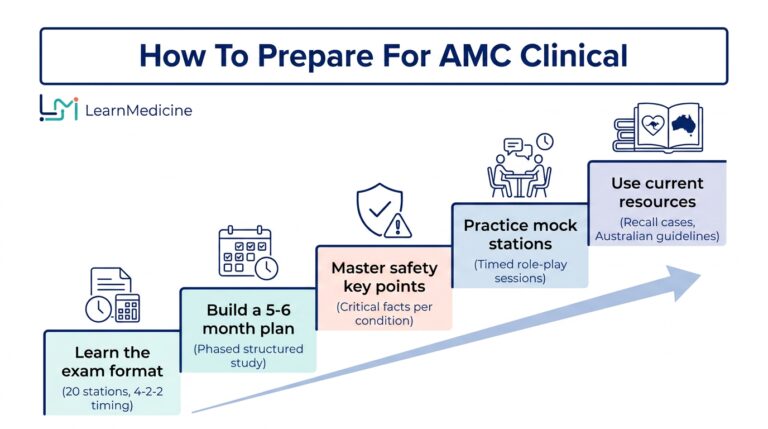
Preparation time depends heavily on recent clinical experience, English fluency, and how much time a doctor can study each week. Many successful IMGs study seriously for three to six months before the exam, using a mix of a structured course and self‑directed work.
Comprehensive eight to twelve‑week courses give a strong base when combined with daily personal practice. Intensive programs work best as a final phase after months of solo study rather than as the only preparation. In general, starting earlier allows more steady progress and avoids the pressure of trying to learn everything in a few stressful weeks.
Question 3: Are Online AMC Clinical Prep Courses As Effective As Face To Face Courses
Both online and face‑to‑face formats have produced many successful candidates. High‑quality online courses that include frequent interactive role plays, small‑group discussions, and direct tutor feedback can be just as effective as classroom programs for many doctors. The key is that online study must involve active participation rather than only watching videos.
Face‑to‑face courses still hold advantages for hands‑on physical examination practice and for building social support. Hybrid models that use online teaching plus short in‑person workshops aim to capture the strengths of both styles. LearnMedicine’s online interactive model, with at least four weekly live sessions, shows how an online course can still feel very personal and focused.
Question 4: How Important Are Mock Exams In AMC Clinical Preparation
Mock exams sit near the top of the list of tools that successful candidates mention when they describe what helped most. A full mock with timed stations, real exam‑style instructions, and trained examiners gives an honest picture of performance under pressure. It exposes weak areas in communication, examination technique, and time management long before the real exam.
Feedback from these trials is often more powerful than any textbook chapter because it is specific and personal. Courses that include several mocks spread across the preparation period give repeated chances to fix problems and measure progress, which usually leads to better results.
Question 5: What Should I Look For In AMC Clinical Prep Course Tutors
Good tutors bring more than knowledge of guidelines. They combine real clinical experience, recent familiarity with the exam, and the ability to explain ideas clearly at different levels. Many IMGs value teachers who have walked the same path, since they understand cultural adjustments and common mistakes.
Helpful tutors provide specific feedback rather than vague comments and are willing to answer questions outside strict class times through email or chat groups. Smaller tutor‑to‑student ratios also allow more individual attention. Before enrolling, it helps to read tutor profiles, watch any sample lessons, or attend trial classes to see whether their style matches personal needs.
Question 6: Can I Prepare For The AMC Clinical Exam Without Taking A Prep Course
Some doctors do pass the exam through self‑study alone, but this path is more challenging and often slower. The exam format is different from everyday ward work, and it can be hard to arrange realistic role plays and honest feedback without outside help.
High‑quality courses bring structure, recall‑based focus, and repeated mock stations that are difficult to recreate alone. For IMGs on very tight budgets, a middle path can work well, such as several months of personal study using guidelines and recall notes, followed by a shorter intensive course close to the exam date.
 Google