
"AMC registration" usually means opening an Australian Medical Council account and portfolio so your qualifications can be verified and assessed. It is not medical registration. The Medical Board of Australia, supported by Ahpra, decides registration, and each international medical graduate (IMG) pathway (Standard, Competent Authority or Specialist) has its own assessments, supervision and evidence requirements.
Key takeaways
- The AMC handles assessment, and ECFMG/Intealth performs primary-source verification of your qualification. The AMC does not grant registration, issue visas or find jobs.
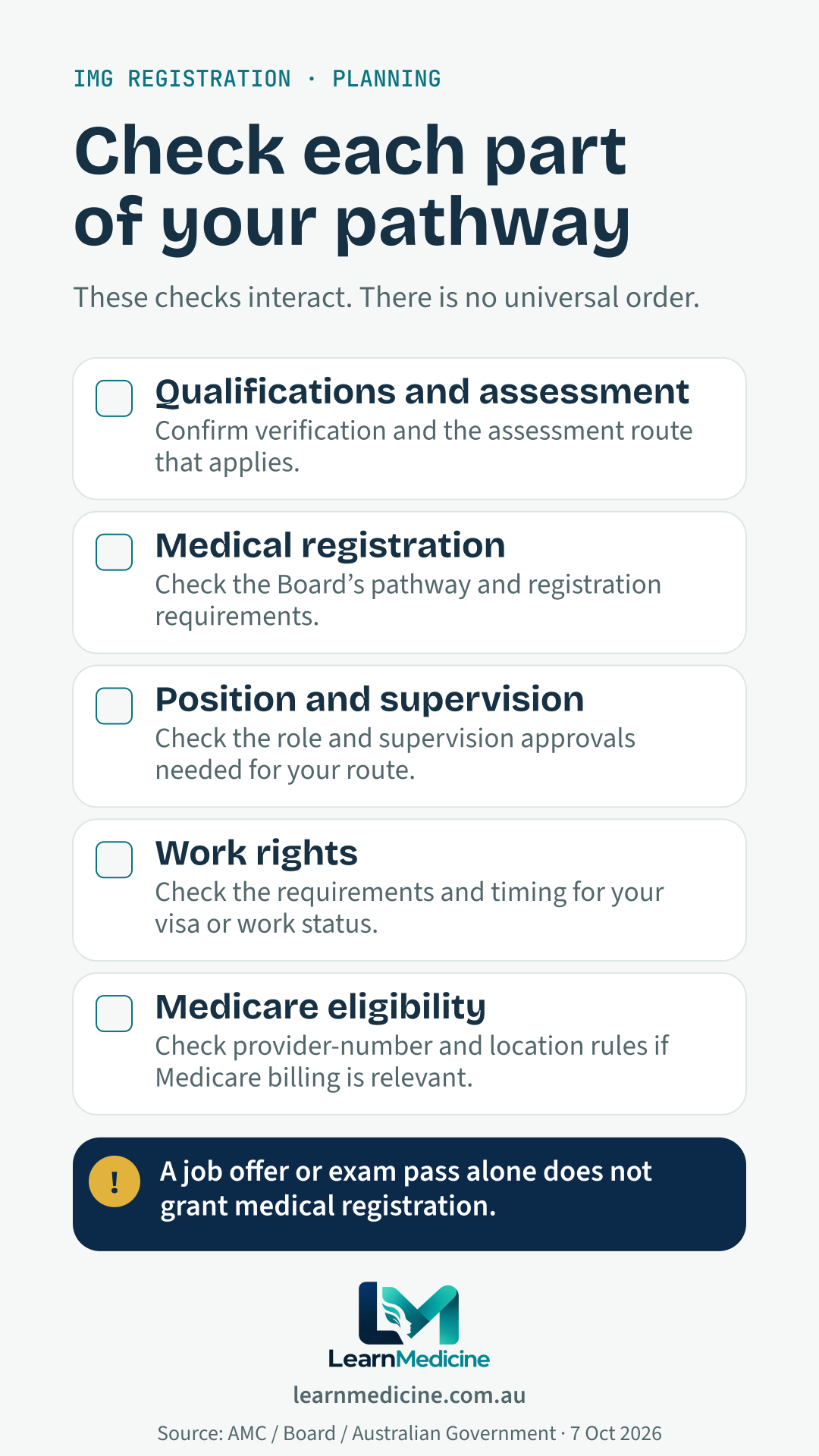
- Five separate decisions shape your path: AMC assessment, medical registration, employment, work rights and Medicare billing. Different organisations make each one.
- On the Standard pathway, you pass the AMC MCQ, then either the AMC Clinical examination or a workplace-based assessment (WBA), and complete Board-approved supervised practice. No single exam pass, elapsed time or job offer on its own equals general registration.
- The Competent Authority pathway has seven categories, each with an assessment component and an experience component. The Board also lists specified cross-category combinations and Australian experience substitutions. Registration with the UK's General Medical Council (GMC) alone does not make you eligible.
- Specialist routes differ. College specialist recognition, the Expedited Specialist pathway, and area-of-need or short-term training roles lead to different outcomes.
- English test rules changed for tests taken from 23 April 2026, so check Ahpra's current tables for your test date.
- This guide does not include a pathway quiz. Use the Medical Board's official self-assessment tool and pathway pages.
Source check: pathway rules in this guide were checked against official AMC, Medical Board of Australia, Ahpra, Home Affairs and Services Australia pages on 7 October 2026. This is general information, not an eligibility decision. Confirm your situation with the relevant body.
Is AMC registration the same as medical registration?
Five separate decisions
Much of the confusion IMGs describe online comes from treating these as one process. They are five decisions, made by different organisations:
| Decision | Who decides | What it does not do |
|---|---|---|
| AMC assessment (exams, WBA, credentials), using primary-source verification of your qualification | Australian Medical Council (AMC); ECFMG/Intealth performs the verification | It does not grant registration |
| Medical registration (limited, provisional, general or specialist) | Medical Board of Australia, supported by Ahpra (the Australian Health Practitioner Regulation Agency) | It does not give you a job or a visa |
| Employment | The employer: a hospital, health service or practice | It does not decide whether you are registrable |
| Work rights (visa) | Department of Home Affairs | It does not assess your medical qualifications |
| Medicare billing (provider number and any restrictions) | Services Australia | It is not automatic with registration |
Who assesses and who grants registration
The AMC's pathways page is clear that the AMC is responsible for assessment, not registration. Through the AMC's application process, you check that your medical school, degree title and graduation year are eligible, have your primary qualification verified, and set up an AMC account and portfolio. Your medical school issues the qualification; ECFMG/Intealth carries out the primary-source verification through MyIntealth (the EPIC credential verification service). The Medical Board of Australia then decides registration against its pathway rules and registration standards.
Which IMG pathway should I investigate?
The AMC groups the routes into four broad pathways: Standard, Competent Authority, Specialist (which includes the Expedited Specialist route) and short-term training. The Medical Board presents the Expedited Specialist route separately. Either way, the routes are the same. What matters is matching your actual training and assessment history to the right one.
Standard pathway
This route suits IMGs who are not eligible for the other pathways. According to the Board's Standard pathway page, you pass the AMC MCQ examination, then either the AMC Clinical examination or an accredited WBA program. WBA requires medical registration and an appointment to an approved clinical position, as the AMC's WBA eligibility page explains. Along the way, you work under Board-approved supervision on limited or provisional registration in an approved position before you can apply for general registration. The Board's page explains which registration type applies at each stage and what the supervision must look like. Passing an exam, completing a set amount of time, or receiving a job offer does not on its own amount to general registration. If the Clinical examination is your next step, our guide to AMC Clinical topic preparation shows how to plan your practice.
Competent Authority pathway
The Board's Competent Authority page sets out seven categories. Each has an assessment component (a prescribed examination or assessment) and an experience component. The page also lists specified combinations of an assessment from one category with experience from another, and specified Australian experience that can be substituted. Check your history against the exact categories, combinations and substitutions listed. Holding registration in a particular country, including GMC registration in the UK, does not by itself establish eligibility. This route does not require AMC examinations, but you still need to meet the registration standards and have your position and supervision approved. If the Board registers you, you hold provisional registration while you complete the required period of supervised practice, before applying for general registration.
Specialist and Expedited Specialist pathways
The Board's specialist pathway page separates several routes for overseas-trained specialists. They are not interchangeable:
- Specialist recognition through a college: you must meet the specialist eligibility criteria on the Board's specialist recognition page; overseas experience alone is not enough. The relevant specialist college then assesses how comparable your training is to an Australian specialist's. Under the Board's process, applicants assessed as substantially or partially comparable must complete the college's requirements before the college makes its final recommendation. Only then can the Board grant specialist registration.
- Expedited Specialist pathway: if you hold a qualification on the Board's accepted list, you can apply directly to the Board, but the qualification alone does not grant registration. According to the Board's Expedited Specialist page, successful applicants receive specialist registration with conditions. These usually require six months of full-time equivalent (FTE) supervised practice in an approved position, unless the Board assesses that a relevant exemption applies, plus cultural safety education, orientation and workplace assessments. Part-time practice takes longer, and the requirement is met by completing the supervised practice and assessments, not by six calendar months passing. The Board's FAQ for specialist IMGs explains these conditions and their timing.
For GPs, RACGP's guidance treats specialist registration and RACGP Fellowship as separate milestones, so do not assume one automatically brings the other.
Area-of-need and short-term training limits
Some overseas specialists work in a specific area-of-need position, and some specialists or specialists-in-training come for short-term specialist training. In both routes, the relevant specialist college assesses you for that particular position or training post, and the Board decides registration. You must also meet each route's own eligibility: specialist qualifications for the area-of-need specialist route, and, for short-term training, specialist qualifications or the Board's criteria for specialists-in-training near completion. Current enrolment in specialist training does not qualify you by itself: trainees normally need to be within two years of completing their training, and the Board's short-term training guidelines set out the exact criteria, including a specified exception. A secured job or training post alone is not enough. These routes are tied to that position or post, and they do not automatically lead to specialist registration. If your long-term goal is specialist recognition, check how, or whether, your route connects to it before you commit. The Board's area-of-need page and short-term training page set out the requirements.
How do pathways differ from registration types?
Limited, provisional, general and specialist status
A pathway is the route you take. A registration type is the status the Board grants you at each stage.
- Limited registration: supervised practice in a specific approved position or for a specific purpose.
- Provisional registration: supervised practice in an approved position while you complete the supervised practice the Board requires on your pathway.
- General registration: granted once you have met your pathway's requirements, including its assessments and supervised practice, and the registration standards.
- Specialist registration: for recognised specialists, either after a college's final recommendation or, on the Expedited Specialist route, initially with conditions that include supervised practice in an approved position.
Primary-linked comparison
| Pathway | Who assesses | Entry evidence | Registration while you progress | Next required milestone |
|---|---|---|---|---|
| Standard | AMC (MCQ, then Clinical or WBA); Board for registration | Eligible, verified primary qualification; AMC MCQ pass | Limited or provisional, with supervision in an approved position | Complete Clinical or WBA and the required supervised practice, then apply for general registration |
| Competent Authority | Board, against the seven categories and its specified combinations and substitutions | A prescribed assessment plus the required experience, within one category or in a specified combination or Australian experience substitution | Provisional registration, with supervised practice in an approved position | Complete the required supervised practice, then apply for general registration |
| Specialist recognition (college) | Specialist college assesses comparability; Board registers | Verified specialist qualifications that meet the Board's eligibility criteria, then college assessment | Depends on the college outcome and position. Check the Board's page | Complete college requirements, then the college's final recommendation, then specialist registration |
| Expedited Specialist | Board, directly | A qualification on the Board's accepted list, plus the Board's application requirements; the qualification alone does not grant registration | Specialist registration with conditions; an approved position and supervision before you start work | Usually six months FTE supervised practice (longer if part-time; Board-assessed exemptions may apply), plus cultural safety education, orientation and workplace assessments |
| Area-of-need specialist | Specialist college assesses you for the specific position; Board decides registration | Specialist qualifications, a college assessment for the position and an offered area-of-need position; the job alone is not enough | Tied to that position | Does not automatically lead to specialist registration |
| Short-term training | Specialist college assesses you for the specific training post; Board decides registration | Specialist qualifications, or specialist training that meets the Board's trainee criteria (normally within two years of completion; other criteria and a specified exception apply), plus a college assessment for the post and an offered training post; current enrolment or the post alone is not enough | Tied to that training post | Does not automatically lead to specialist registration |
Do I need a job offer before applying?
Conditional sequencing
For the initial AMC steps (eligibility, verification and portfolio) and the AMC examinations, no job is needed. WBA is different: it requires registration and an appointment to an approved clinical position. For limited or provisional registration, the Board looks at a specific approved position with appropriate supervision. In practice, that means you need a suitable position and supervisor before that registration can be granted. Your employer and proposed supervisor supply key parts of the paperwork, such as the position details and supervision plan. The Board's pathway pages explain exactly what the application needs.
Two branches change the order:
- General practice roles: if you are on the Standard or Competent Authority pathway and need limited or provisional registration for a general practice role, you will need a PESCI (Pre-Employment Structured Clinical Interview) for that position. The Board's Competent Authority page currently makes one narrow exception: Competent Authority applicants who are concurrently applying for GP assessment through the Specialist pathway. The exception is specific to that concurrent application. If you are seeking limited registration for an area-of-need GP role, the Board's guidance is to have your experience assessed first. Our guide explains what PESCI is and when it applies.
- Specialist routes: there is no single order. On the Expedited Specialist pathway, you may be able to apply before you have a job offer, but this is not mandatory, and you need an approved position and supervision before you start work. Area-of-need and short-term training routes depend on a specific offered position or training post, as well as the college's assessment and the Board's decision. For college specialist recognition, follow the steps on the Board's specialist recognition page.
What can happen in parallel
You can usually work on several things at once:
- the AMC eligibility check, MyIntealth verification and AMC portfolio
- English test preparation and booking, timed so your result is valid when you apply
- exam preparation; see our tips for planning clinical examination study
- gathering good-standing and experience evidence
- searching for a suitable position
Visa and Medicare steps depend on the job and the registration you are granted. There is no universal visa-first or registration-first order: the requirements of the relevant visa decide the sequence.
Which documents and standards should I check first?
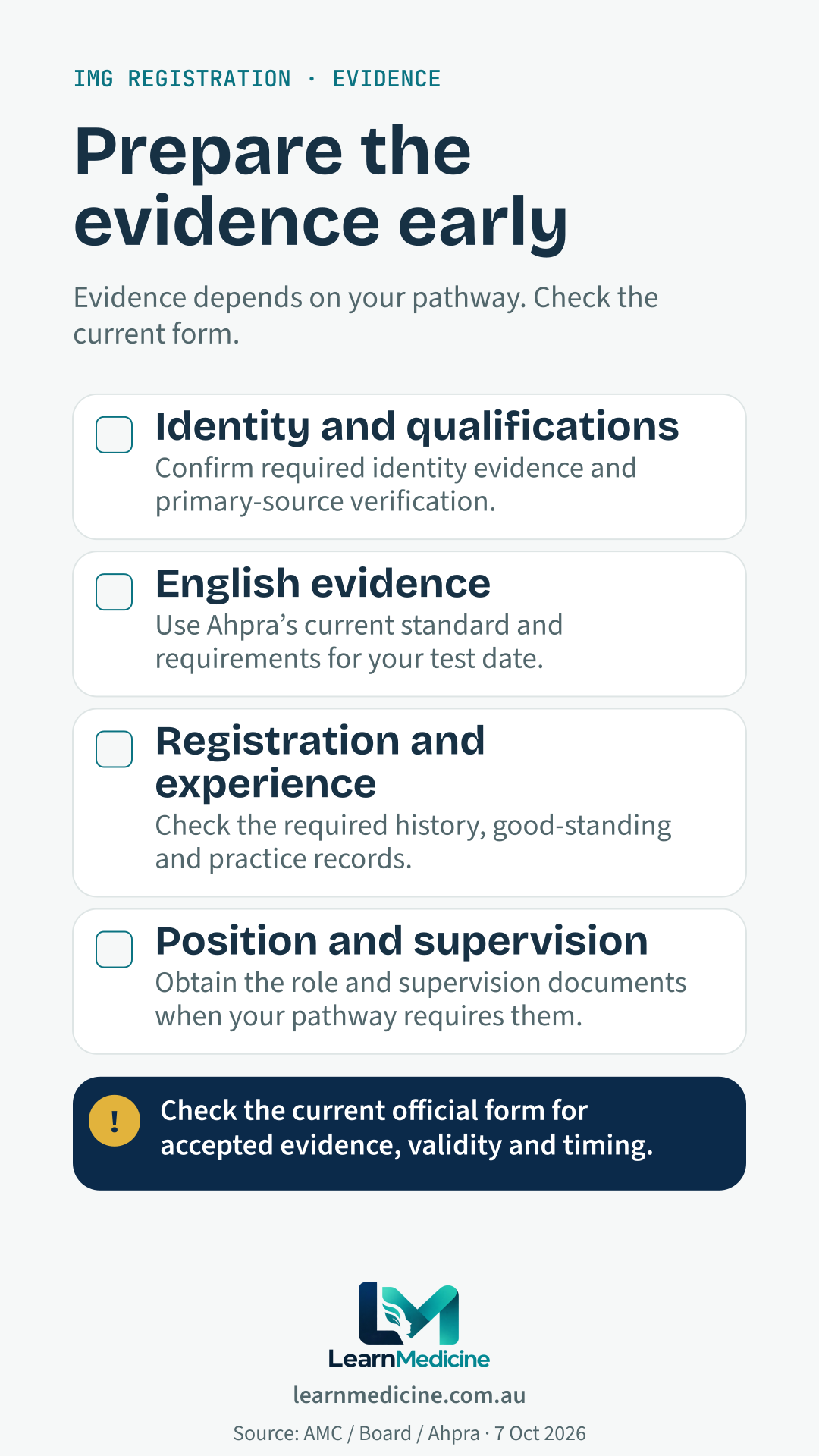
Verification, English and experience evidence
Before you spend money on exams or travel, check three things:
- Eligibility of your degree: the AMC checks your medical school, degree title and graduation year together. All three must match.
- English language: Ahpra's accepted English tests page has separate tables for tests taken before and from 23 April 2026. Rules for combining results from more than one sitting apply only in specific circumstances. Do not reuse scores from older forms or forum posts.
- Experience and recency: internship and recent practice evidence matter for registration. Use the current Board application form and registration standards to see exactly what is accepted.
Expiry and source checklist
| Evidence | Issued by | Relevant to | Timing check | Who decides if it is acceptable |
|---|---|---|---|---|
| Primary medical qualification and its primary-source verification | Your medical school issues the qualification; ECFMG/Intealth verifies it through MyIntealth (EPIC) | All pathways | Start early; verification depends on your school's response | AMC (and the Board for registration) |
| English test result | An accepted test provider | Most applicants; the English language standard sets out the accepted ways to show English skills | Check validity and test-date rules in Ahpra's current tables | Ahpra and the Medical Board |
| AMC exam or WBA results | AMC | Standard pathway | Check the AMC portfolio for current status | AMC (assessment); Board (registration) |
| Competent Authority assessment and experience evidence | The overseas assessing body and employers | Competent Authority pathway | Match the exact wording of your category, combination or Australian experience substitution | Medical Board |
| Certificates of good standing and registration history | Overseas regulators | All pathways | Check how recent they must be on the current form | Medical Board |
| Position description and supervision plan | Employer and supervisor | Limited and provisional registration; supervised practice under conditional Expedited Specialist registration | Must match the actual role | Medical Board |
What do an exam pass and registration not guarantee?
Employment and training
Being eligible to seek registration, being offered a suitable supervised job, and being selected for specialist training are three separate hurdles. No exam result, and no general talk of workforce shortages, guarantees an individual job offer. Employers choose against their own criteria. Specialist training selection is run by the colleges and training employers, with their own eligibility rules.
Work rights and Medicare are separate
Registration does not give you a visa. Work rights are decided by the Department of Home Affairs, and visa applications for doctors can require evidence of medical registration. We cannot advise on individual visa choices, so use official Home Affairs information or a registered migration agent.
Registration also does not give you Medicare billing rights. Services Australia's IMG eligibility page explains that registration alone is not Medicare eligibility. Location-based restrictions and exemptions may apply to some IMGs, and they are assessed when you apply for a provider number. Services Australia's Medicare definition of an IMG is also broader than the overseas-qualification meaning used for registration pathways: it includes certain graduates of Australian or New Zealand medical schools, based on their overseas status.
Once you are registered, continuing professional development (CPD) becomes part of your yearly obligations, unless an exemption under the Board's CPD registration standard applies to you. Our guide to Ahpra CPD requirements for doctors explains how that works.
How do I check a difficult pathway scenario?
Illustrative qualification and experience examples
These examples are illustrative only. None of them is an eligibility decision. Only the AMC and the Medical Board can make those.
- A non-specialist doctor who has just passed the AMC MCQ: the MCQ pass does not decide your pathway, and it does not rule out the Competent Authority pathway. The missing facts are your other assessments and experience. If they fit a Competent Authority category, combination or substitution, that route may be open. If not, on the Standard pathway the next questions are whether to pursue the Clinical examination or WBA, and whether a suitable supervised position is available.
- A doctor with full GMC registration obtained without PLAB, working in the UK's National Health Service (NHS): GMC registration alone does not establish Competent Authority eligibility. Compare your actual assessment history and experience with each category's exact wording, and with the specified combinations and Australian experience substitutions. If nothing fits, investigate the Standard pathway, or a specialist route if you meet its eligibility criteria.
- An experienced overseas physician: experience alone does not establish eligibility for a specialist route. The missing facts are whether you meet the Board's specialist eligibility criteria and, if so, whether your qualification is on the Board's accepted list for the Expedited Specialist pathway. If it is, that route may apply; if you are eligible but it is not, college specialist recognition is the route to investigate. If you are not eligible as a specialist, compare your history with the Competent Authority and Standard pathways. An area-of-need role on its own will not lead to specialist registration.
- An IMG offered a general practice role: expect a PESCI for that position on the Standard or Competent Authority pathway, unless you are a Competent Authority applicant concurrently applying for GP assessment through the Specialist pathway (the Board's narrow exception). If it is an area-of-need limited-registration role, get the experience assessment done first.
- A graduate of an Australian medical school: for initial and general registration, the IMG pathways in this guide are for doctors whose primary medical qualification is from outside Australia and New Zealand, so your route to that registration is different. An overseas specialist qualification is the exception. The Board's page for Australian and New Zealand graduates with overseas specialist qualifications explains that if your qualification is on the Board's accepted list, you can apply through the Expedited Specialist pathway. If it is not, the relevant specialist college can assess it through a process the Board describes as similar to, but not the same as, specialist recognition for specialist IMGs. Medicare is separate: Services Australia's IMG definition is broader and includes certain Australian or New Zealand graduates, based on their overseas status, so check its page if that may apply to you.
Official decision tool instead of a quiz
An earlier version of this page promised an interactive pathway quiz, but no quiz was present on the page when it was checked for this update, so the promise has been removed. Instead, use the Medical Board's official self-assessment tool, introduced on the Board's specialist pathway page and linked from the AMC's pathways page, together with the pathway pages linked throughout this guide. If your situation still does not fit, contact Ahpra or the AMC directly with your documents in hand.
What do IMGs ask about their next step?
Is opening an AMC account the same as getting medical registration?
No. The AMC account and portfolio are for verification and assessment. Registration is decided by the Medical Board of Australia, supported by Ahpra.
Do I need a job offer before applying for limited or provisional registration?
For those registration types, the Board assesses a specific approved position with supervision, so you need a suitable position in practice. AMC steps such as verification and exams do not need a job, but WBA requires registration and an approved clinical position.
Does GMC registration without PLAB qualify me for the Competent Authority pathway?
Not by itself. Each of the seven categories pairs a prescribed assessment with required experience, and the Board also lists specified cross-category combinations and Australian experience substitutions. Check your history against the exact criteria on the Board's page.
Can I look for an Australian job after the AMC MCQ, before Clinical or WBA?
You can look, and the Board's Standard pathway page explains when supervised registration in an approved position is possible. Being able to apply is not the same as being offered a role. You still need the Clinical examination or WBA, and the required supervised practice, for general registration. WBA itself requires registration and an approved clinical position, and an MCQ pass does not rule out the Competent Authority pathway if your history fits it.
When does a proposed GP role require a PESCI?
When you are on the Standard or Competent Authority pathway and need limited or provisional registration for a general practice role. Specialist and Expedited Specialist pathway applicants are exempt. The Board's Competent Authority page also makes a narrow exception for Competent Authority applicants concurrently applying for GP assessment through the Specialist pathway. Area-of-need limited-registration applicants should have their experience assessed first.
Which English test results can be combined, and which dates matter?
Ahpra's accepted-tests page sets out which tests, scores and combinations are accepted, with separate tables for tests taken before and from 23 April 2026. Combining results from two sittings is allowed only in specific circumstances, so check the table for your test date rather than relying on forum answers.
What is the difference between general registration, specialist registration and specialist training?
General registration is granted once you have met your pathway's requirements and the registration standards. Specialist registration recognises you as a specialist. Specialist training is a separate college program with its own selection process, and registration does not guarantee entry.
Does registration give me work rights and unrestricted Medicare billing?
No. Visas are decided by Home Affairs, and Medicare provider numbers and any location-based restrictions are handled by Services Australia.
Sources
Official pages checked on 7 October 2026:
- Australian Medical Council: Pathways, How to apply and WBA eligibility and how to apply
- Medical Board of Australia: Standard pathway, Competent Authority pathway, Specialist pathway, Specialist recognition, Area of need, Short-term training, Short-term training guidelines, Expedited Specialist pathway, FAQ for specialist international medical graduates and Australian and New Zealand graduates with overseas specialist qualifications
- Ahpra: Accepted English language tests (changes effective 23 April 2026)
- Services Australia: International medical graduates eligibility requirements
About LearnMedicine
This guide is published by LearnMedicine. LearnMedicine's founder, Dr Roman Pathak, is an Australian GP and educator. Read more about LearnMedicine.