
Key Takeaways
Table Of Contents
Introduction
For many international doctors, the AMC Clinical Exam feels like a single gate between years of training overseas and real work in Australia. It is where medical theory meets Australian clinical practice, and where every station can move a career forward or delay it. With pass rates around 21% for IMGs in recent reporting periods, this exam carries significant pressure. Each year, more than 2,000 IMGs attempt the AMC clinical exam, yet fewer than 1 in 5 pass on their first sitting.
Many candidates know medicine well yet still struggle. The reason is simple: the AMC clinical exam does not test facts alone. It checks communication, clinical reasoning, time management, cultural awareness, and whether you work safely within the Australian health system. Passing on the first attempt takes more than long hours of reading; it requires a clear, structured plan and realistic, timed practice.
In this guide, we walk through what the AMC clinical exam covers, who can sit it, how it is structured and scored, and how to prepare in a focused way. We draw on experience at LearnMedicine, working with IMGs through recall‑based teaching, structured OSCE practice, and career support. By the end, you will know what examiners look for, how to avoid common mistakes, and how a systematic approach can make a first‑time pass a realistic goal.
“Success depends upon previous preparation, and without such preparation there is sure to be failure.”
— Confucius
Key Takeaways
The AMC Clinical Exam is a high‑stakes OSCE that assesses whether you can work safely at intern level in Australia.
The circuit has 20 stations (16 assessed, 4 rest). Your final result is based on 14 scored stations, and you must pass at least 9 to pass overall.
You must first pass the AMC CAT MCQ exam before you can schedule the clinical exam.
Stations focus on four key domains: history taking, physical examination, diagnostic formulation, and management with counseling and education.
Examiners expect clear English, knowledge of Australian guidelines, and culturally safe care, including with Aboriginal and Torres Strait Islander patients.
Most IMGs benefit from at least four months of organized practice; those out of clinical work or new to OSCEs often need six months.
What Is The AMC Clinical Exam?

The AMC Clinical Exam is a practical, performance‑based Objective Structured Clinical Examination (OSCE) that checks whether international medical graduates (IMGs) can work safely at intern level in Australia. It is part of the Standard Pathway to registration. Only candidates who have already passed the AMC CAT MCQ (Part 1) can progress to the clinical exam. The AMC reports that approximately 60% of candidates who sit the clinical exam come from Asia, South Asia, or the Middle East, reflecting the diverse international backgrounds of IMGs seeking registration in Australia.
During the exam, you rotate through a circuit of short clinical stations based on common Australian presentations. In each station, you may be asked to:
Take a focused history
Perform a relevant physical examination
Form a differential diagnosis and working diagnosis
Explain investigations and management plans
Provide counseling, education, or safety‑net advice
Content spans adult medicine, surgery, women’s health, pediatrics, and mental health, in both hospital and community settings. Some stations feel like general practice consultations; others mirror ward reviews or emergency department encounters.
Examiners judge far more than your clinical steps. They observe:
How you listen and respond to patients
How clearly you explain options and risks
How you show empathy and respect
Whether your decisions match Australian standards and safety expectations
How you behave under time pressure and stress
In simple terms, the exam asks: Can this IMG function as a safe, professional junior doctor in Australia?
AMC Clinical Exam Content And Syllabus By Discipline
The AMC clinical exam draws its cases from a broad syllabus designed to mirror everyday work for a junior doctor. Understanding the scope of content helps you plan your study rather than guessing. According to AMC documentation, approximately 40% of cases come from adult medicine, with the remaining 60% spread across surgery, women’s health, pediatrics, and mental health.
Core Clinical Areas
You can expect scenarios from five main disciplines:
Adult Medicine
Chest pain, dyspnea, abdominal pain, headache, syncope, infections
Chronic disease care: diabetes, hypertension, heart failure, COPD, chronic kidney disease
Emergency recognition: sepsis, acute coronary syndrome, stroke red flags
Adult Surgery
Acute abdomen, bowel obstruction, postoperative fever or pain
Trauma principles, wound care, pre‑operative assessment, post‑operative complications
When to escalate urgently to surgical or emergency teams
Women’s Health (Obstetrics And Gynecology)
Early pregnancy bleeding, antenatal care, contraception counseling
Abnormal uterine bleeding, pelvic pain, sexually transmitted infections
Shared decision‑making around screening and procedures
Child Health (Pediatrics)
Fever, cough, vomiting, diarrhea, rash, poor weight gain
Developmental milestones and immunization questions
Recognizing a sick child and when to arrange urgent review
Mental Health
Depression, anxiety, psychosis, suicidal ideation, substance use
Risk assessment, brief interventions, and safety plans
Medication initiation and referral pathways within the Australian system
Indigenous Health And Cultural Safety
The AMC places specific emphasis on culturally safe care for Aboriginal and Torres Strait Islander peoples. Aboriginal and Torres Strait Islander peoples make up approximately 3.8% of Australia’s population, yet experience significantly higher rates of chronic disease and face well-documented barriers to healthcare access. This may appear as:
Scenarios involving Indigenous patients or communities
Questions about the impact of social determinants of health
Expectations around respectful communication and shared decision‑making
Before the exam, review the AMC’s Indigenous Health material and think carefully about:
How you ask about culture, family, and community in a respectful way
How you explore barriers such as transport, cost, or past negative experiences
How you work with patients rather than making assumptions for them
Showing cultural awareness and humility can strongly influence global ratings in many stations.
AMC Clinical Exam Eligibility And Scheduling
Eligibility for the AMC Clinical Exam is straightforward:
You must have a confirmed pass in the AMC CAT MCQ (Part 1).
Without this pass, you cannot book a clinical exam place.
The clinical exam sits within the Standard Pathway, which—together with the MCQ exam—leads to the AMC Certificate, a core requirement for AHPRA registration via the standard route. As of 2025, there are more than 10,000 IMGs registered to practice in Australia, representing roughly 40% of the total medical workforce in some regional and remote areas.
Scheduling And Competition For Places
Scheduling, however, can be challenging. The AMC opens booking windows for specific exam periods throughout the year, with a regular pause during December and January. Demand is high, so:
Places can disappear within minutes of release.
On busy days, the booking system may slow or time out.
When system issues occur, the AMC can review logs and manually place affected candidates into later sessions.
For online exams, priority is often given to IMGs already working in rural and remote Australian areas so they can progress to full registration and continue serving high‑need communities.
If you miss a place, you can usually join an Expression of Interest (EOI) list for future openings.
Practical Scheduling Tips
To make booking smoother and less stressful:
Check the AMC website and your candidate account regularly around expected release dates.
Keep your login details and payment card ready before each scheduling window opens.
Have backup months in mind in case your preferred date fills quickly.
Keep travel and leave plans flexible until your booking is confirmed; dates can change or be canceled.
Aim to schedule when your preparation is on track, rather than chasing the very earliest available slot.
Understanding The Exam Structure And Format
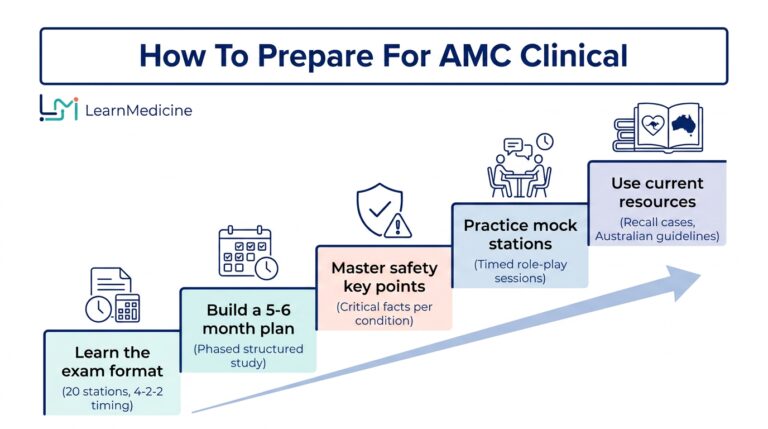
The AMC clinical exam uses a classic Objective Structured Clinical Examination (OSCE) format. You move around a fixed circuit of 20 stations:
16 assessed stations
4 rest stations
Each station runs for 10 minutes, divided into:
2 minutes of reading time outside the room or before the video starts
8 minutes of performance time inside the station under direct observation
The total circuit time across all 20 stations equals approximately 200 minutes of station time, meaning candidates spend around 3.5 hours actively rotating through the exam before accounting for briefing and administrative time.
Making The Most Of Reading Time
Those two minutes of reading time are critical. Effective candidates use them to:
Skim the stem and identify the main task (for example, history, exam, management)
Note key details: setting (ED, ward, clinic), urgency, and patient concerns
Decide on a simple structure (for example, “pain history → red flags → risk factors → impact”)
Prioritize essential questions, examination steps, and management points
Going into the station with a clear plan reduces rambling and helps you finish within eight minutes.
Station Formats
Stations may use:
Simulated patients played by trained actors
Video clips of patient encounters, followed by questions
Charts, blood results, imaging, and photos to interpret
Written prompts requiring you to explain a diagnosis, consent for a procedure, or adjust treatment
The mix reflects both general practice and hospital work across multiple disciplines.
Rest Stations
Rest stations are spaced through the circuit to provide short mental breaks. Many candidates use this time to replay previous stations, which often increases anxiety. A more helpful approach is to:
Take a few slow breaths to reset your nervous system
Consciously let go of the last station—good or bad
Glance at the station type coming up next (if visible) and think about your basic structure
Regular timed OSCE practice before the exam trains you to fit within the 2 + 8‑minute pattern and helps reduce on‑the‑day stress.
What The Exam Assesses: Key Competencies And Domains
The AMC clinical exam focuses on four major domains that mirror everyday junior doctor work in Australia. Most stations emphasize one main domain but still touch several others. Research into OSCE performance consistently shows that communication skills account for as much as 30–40% of the global rating in each station, making them as important as clinical knowledge.
History Taking
In history‑focused stations, examiners look for a clear, logical, patient‑centered interview. Strong candidates:
Begin with the main concern:
“What brought you in today?“Use open questions first, then focused closed questions
Cover past medical, medication, family, and social history where relevant
Keep questions relevant to the stem, not random or checklist‑driven
Listen carefully and respond to verbal and non‑verbal cues
Summarize and check understanding at the end
They also show empathy and respect:
Acknowledge emotions: “It sounds like this has been really worrying for you.“
Avoid judgmental language around topics such as weight, smoking, alcohol, or sexual history.
Use language that matches the patient’s level of understanding.
“The good physician treats the disease; the great physician treats the patient who has the disease.”
— William Osler
Physical Examination

Physical examination stations test whether you can perform a focused, safe, efficient exam that matches the scenario. Examiners watch for:
Correct technique and logical order (inspection → palpation → percussion → auscultation, where appropriate)
Attention to important signs and red flags
Clear explanations of what you are doing and why
Consent and privacy, including proper draping
Verbalizing important findings during or after the exam
Common pitfalls include rough handling, missed red flags, and disorganized technique. Even when your knowledge is strong, these issues can lead to low scores. Studies of OSCE performance indicate that candidates who verbalize their findings during examination score, on average, 15–20% higher on examiner global ratings than those who examine silently.
Practice on colleagues or in study groups, and get feedback on:
Hand position and comfort
Eye contact and explanations
Whether your exam is appropriately focused rather than “head‑to‑toe” in every case
Diagnostic Formulation
Diagnostic formulation is where you pull information together into a coherent clinical picture. The AMC expects you to:
State a short, sensible list of differential diagnoses
Explain why one diagnosis is most likely
Link your thinking to key positive and negative findings
Outline appropriate investigations in a logical order
Match investigations and referrals to the Australian setting (Medicare, PBS, local services)
Examiners prefer structured, safe reasoning over guessing rare conditions. A good approach is:
Lead with the most likely diagnosis, supported by evidence.
Mention one or two serious alternatives you must not miss.
Clearly state which investigations you would order now, which can wait, and what you are looking for.
Management, Counseling, And Education
Management and counseling stations test how you turn a diagnosis into practical action and communicate that plan. Strong performance usually includes:
Immediate safety steps (red flags, emergency care if needed)
Medication choices consistent with Australian guidelines (for example, Heart Foundation, RACGP, eTG)
Non‑drug measures and lifestyle advice
Clear follow‑up plans and when to seek urgent help
Shared decision‑making and checking understanding
Addressing the patient’s worries, values, and goals
Arranging appropriate referrals and tests within the Australian system
Examiners look closely at whether the plan is safe, realistic, and explained in plain language. Saying “I’d follow guidelines” without showing you know what they recommend is not enough. Practice saying out loud:
Specific drug names and first‑line doses used in Australia
Concrete safety‑net advice: “If the pain suddenly worsens, or you feel short of breath, call 000 or go straight to the emergency department.“
Clear follow‑up timing: “I’d like to review you in one week, or sooner if symptoms get worse.“
AMC MCQ (Part 1) Vs AMC Clinical Exam
Understanding how the AMC CAT MCQ and the AMC Clinical Exam fit together helps you plan your pathway and budget your time, money, and energy. The AMC CAT MCQ exam fee is approximately AUD 2,500–3,000, while the AMC Clinical Exam fee is considerably higher, often exceeding AUD 5,000, making the total cost of the Standard Pathway one of the most significant financial commitments for IMGs.
Side‑By‑Side Comparison
| Feature | AMC CAT MCQ (Part 1) | AMC Clinical Exam |
|---|---|---|
| Purpose | Tests applied medical knowledge across all major disciplines | Tests practical clinical skills and judgment at Australian intern level |
| Format | Computer‑based exam with multiple‑choice questions (single best answer) | OSCE with 20 stations (16 assessed, 4 rest) involving simulated patients, videos, and data |
| Duration | Single long session (check AMC website for current timing) | Circuit of stations over several hours; includes briefing and breaks |
| Skills Tested | Knowledge of diagnosis, investigations, and management; ability to interpret data | History, exam, communication, clinical reasoning, counseling, professionalism, cultural safety |
| Setting | Pearson VUE test centers or designated venues | AMC National Test Center and approved sites, or monitored online sittings |
| Cost | Several thousand AUD; paid on scheduling (exact fees change—confirm on the AMC website) | Generally more expensive than the MCQ exam; exact fee published on the AMC website |
| Outcome | Required before booking the AMC clinical exam | Together with MCQ pass, leads to eligibility for the AMC Certificate and AHPRA registration pathways |
Plan your preparation so the knowledge base from the MCQ feeds directly into your practical skills for the clinical exam. If there is a long gap between the two, you may need to refresh MCQ‑level knowledge as you start clinical exam study.
How The AMC Clinical Exam Is Scored: Pass Requirements And Results
The AMC clinical exam currently uses 16 assessed stations, including 2 pilot stations. Pilot stations are new or updated scenarios the AMC is trialing:
They look and feel like normal stations.
Marks from pilot stations are usually not counted in the final result while data is collected.
For most sittings, your final score is based on 14 scored stations (16 assessed minus 2 pilots). If a non‑pilot station has serious problems—for example, unclear instructions or a technical failure—the Clinical Results Panel may replace it with a pilot station so every candidate still has 14 valid scores.
Current Pass Requirement
From 21 March 2024, the pass mark changed. As of 2026, the requirement remains:
Pass: At least 9 passed stations out of 14 scored stations
Fail: 8 or fewer passed stations
This replaced the older requirement of 10 passed stations. Even with the updated pass mark, pass rates for IMGs have stayed around 21% in recent reporting periods, showing how demanding the exam is. By comparison, Australian-trained medical graduates attempting equivalent assessments achieve pass rates of over 85%, underscoring the additional preparation burden faced by IMGs.
Global Rating And Feedback
In each station, the examiner awards a global rating reflecting how safe and competent you appeared. This rating considers:
Completion of key tasks in the main domain
Overall structure and clinical reasoning
Professionalism, empathy, and communication
How you responded when uncertain (for example, involving seniors)
Results are usually released at 4:00 pm (AEST) on the Friday three weeks after the exam and can be downloaded from your AMC account.
A pass in the AMC Clinical Exam, combined with your MCQ pass, leads to the AMC Certificate, which is necessary for AHPRA registration via the Standard Pathway.
Essential Preparation Strategies For First‑Time Success

A deliberate, structured preparation plan is the single most important factor separating first-time passers from repeat candidates in the AMC clinical exam. As discussed in this Complete Guide to Passing the AMC MCQ Exam, structured preparation is key. For the clinical exam, you need a plan covering time, content, practical skills, and official guidance. Candidates who use a structured study program are reported to be up to 3 times more likely to pass on their first attempt compared to those who rely solely on self-directed reading.
Study Timeline And Planning
Most IMGs need at least four months of focused preparation; some benefit from six months if they are new to OSCEs or have been out of clinical work.
Helpful planning steps:
Map out weekly goals by system or topic (for example, Week 1: chest pain and dyspnea; Week 2: abdominal pain and GI bleeding).
Balance reading with speaking practice—aim for daily out‑loud cases, not just silent study.
Schedule mock circuits every 2–3 weeks to rehearse full exam days.
Build in review weeks to revisit weaker domains or disciplines.
Track your performance (for example, station scores out of 10) to see progress and adjust focus.
A simple weekly plan you can consistently follow is far better than intense, irregular bursts of study. Aim to complete at least 50–60 timed practice stations before your exam date to build both clinical confidence and time management under pressure.
Mastering Australian Clinical Guidelines
Examiners want to hear what a safe doctor in Australia would actually do. That means knowing local guidance from sources such as:
RACGP (including the Red Book)
Therapeutic Guidelines (eTG)
National Heart Foundation of Australia and other national bodies
Drug names, first‑line choices, screening intervals, and follow‑up plans may differ from your home country. It helps to:
Create one‑page summaries for common conditions using Australian sources.
Focus on first‑line management, safety‑netting, and follow‑up timing.
Practice saying plans aloud in clear, simple English, including doses and monitoring.
Note key Australian systems: Medicare, the PBS, and typical referral pathways to specialists or hospitals.
Using correct Australian terms and first‑line plans quickly builds examiner confidence in your safety.
Practicing Clinical Scenarios Under Timed Conditions
Reading cases is not enough. You need to practice thinking and speaking under an eight‑minute clock.
Try to:
Practice regularly with partners, taking turns as doctor, patient, and examiner.
Use the real timing: 2 minutes reading + 8 minutes performance for each station.
Record sessions on video for honest review of posture, tone, and structure.
Repeat high‑yield scenarios (chest pain, shortness of breath, abdominal pain, headache, fever in children, mood disorders) many times until the structure feels automatic.
Simulate full mock circuits with 8–10 stations in one sitting to build stamina.
“Practice does not make perfect. Only perfect practice makes perfect.”
— Vince Lombardi
Repeated, realistic practice trains your brain to stay structured even when stressed.
Building Communication And Cultural Safety Skills
A strong candidate in the AMC clinical exam:
Uses plain language instead of jargon
Say “heart attack” before “myocardial infarction“.
Checks understanding with short questions
“Just to be sure I explained that clearly, can you tell me in your own words what the plan is?“
Shows empathy and respect, especially around sensitive issues
Mental health, substance use, reproductive health, domestic violence, and cultural identity.
Demonstrates awareness of cultural safety, especially with Aboriginal and Torres Strait Islander patients
Asking, not assuming, about family, community, and support.
Acknowledging past negative experiences with health services where appropriate.
Exploring barriers such as distance, cost, and mistrust.
During preparation, deliberately practice:
Breaking bad news in a structured way (warning shot → information → pause → respond to emotion → plan).
Discussing risk behaviors in a non‑judgmental manner.
Including social and cultural factors in your management plans.
Using Official AMC Resources
The official AMC resources are essential reading:
Clinical Examination Specifications – explains format, domains, expected level, and sample cases.
Briefing video – shows the flow of exam day so nothing feels unfamiliar.
Tips from examiners – highlight frequent errors and what experienced examiners value.
Suggested reading list – guides your textbook and guideline choices.
Indigenous Health pages – clarify expectations for culturally safe care with Aboriginal and Torres Strait Islander patients.
Return to these resources regularly so your study stays aligned with AMC standards, not guesswork or outdated rumors.
Using Structured Preparation Courses For Success
Structured AMC clinical exam preparation courses give candidates an organized, feedback-driven pathway that self-study alone cannot replicate. Many IMGs find that a structured course is the difference between repeated attempts and a clear pass. Courses can offer:
Organized content and logical study order
Regular timed practice with feedback
Input from experienced tutors and exam‑savvy peers
A community of candidates working toward the same goal
The AMC lists some bridging providers but does not endorse individual programs, so you still need to choose carefully.
At LearnMedicine, our programs are built around what IMGs say they need and what recall data from past sittings show. Our AMC Clinical Course and PESCI courses are AMA CPD Home–approved and offer around 15–25 CPD hours, which also supports GPs with CPD requirements. Members gain access to more than 500 hours of video content focused on high‑yield cases, Australian guidelines, and safe reasoning.
Key features include:
Essential Case Summaries with structured history, examination, investigations, and management plans, plus timing tips.
Four or more live interactive classes each week (Mon, Tue, Thu, Fri, Melbourne/Sydney time) with role‑play and live feedback.
A complete library that supports both AMC Clinical Exam and PESCI preparation.
We also support the wider career path:
CV and cover letter review to match Australian expectations.
Guidance on AHPRA registration, supervision levels, and state recruitment.
A Telegram community for questions, peer practice, and encouragement, with alumni access and quick support from our team.
For many IMGs, this mix of structure, feedback, and community makes preparation feel more organized and less isolating. LearnMedicine candidates consistently report that regular live practice sessions and case-based feedback are the most valuable elements of their preparation.
Technical Requirements For Online Examinations

For online sittings of the AMC clinical exam, the technical setup is as important as clinical knowledge. If requirements are not met, you may not be allowed to sit the exam, even if you have traveled or taken leave from work. Online sittings now account for a growing proportion of all AMC clinical exam attempts, with rural and remote candidates comprising a significant share of online participants each year.
Computer And Software
Device
Desktop or laptop only (no tablets or phones).
Administrator rights to install exam software.
Operating System
Windows 11, or Apple computer running Windows 10 or 11 via a supported method.
Screen Size
At least 14 inches for comfortable reading of text and images.
Camera And Audio
Webcam
Working webcam at eye level so examiners can see your face and upper body.
Headphones
Wired headphones with microphone are mandatory.
No wireless or Bluetooth headphones (to avoid battery and connectivity problems).
A second wired headset tested in advance as backup.
Internet Connection
Stable, high‑speed connection for the full session. A minimum download speed of 10 Mbps and upload speed of 5 Mbps is recommended to ensure uninterrupted video and audio quality throughout the exam.
Test at the same time of day as your scheduled exam (to match network load).
Close other programs, pause automatic updates, and ask others not to stream video.
Keep the AMC contact phone number printed near your desk.
Exam Room Setup
Quiet, private room used by you alone.
Camera sweep at the start to show no other people or study materials.
One mobile phone allowed on silent (no vibration), only for AMC contact if needed.
Complete a full practice run in the chosen room at least a week before the real exam, including:
Joining a video call.
Using your headset.
Sitting for several hours to test comfort, lighting, and noise.
Failure to comply with these requirements can result in exclusion from the exam, even if your clinical preparation is excellent.
Professional Conduct And Exam Day Expectations
The AMC clinical exam assesses professional behavior as well as clinical skill. From the first email or phone call with exam staff to the final station, you are expected to act with respect and courtesy toward:
AMC staff
Examiners
Simulated patients
Fellow candidates
This applies both online and in‑person.
You must follow all instructions from staff and comply with the Clinical Examination Specifications. Problems such as ignoring directions, arguing with supervisors, or trying to bend rules about materials can be treated as breaches.
Serious breaches—like sharing exam content, cheating, or crossing professional boundaries with simulated patients—may lead to:
Withdrawal of current results
Exclusion from that exam session
Bans from future AMC exams
Reports to regulatory bodies for professional misconduct
For in‑person exams, the AMC COVID Safe Workplace Policy applies, which may include vaccination or other public health requirements. Punctual arrival is essential, as late candidates may not be admitted once the briefing starts.
“Medicine is a science of uncertainty and an art of probability.”
— William Osler
Exam Day Timeline: What Actually Happens
While details can evolve, a typical AMC clinical exam day includes:
Pre‑Exam Check‑In
Identity verification and attendance check.
For online exams, room scan and technology check.
Briefing
Explanation of timing, bells or announcements, and movement between stations.
Reminder of rules and what to do if there are technical or other problems.
Station Circuit
You rotate through stations, following prompts or staff direction.
Bells or announcements signal reading time and performance time.
Breaks
Short breaks between circuits or at scheduled times.
Use these for water, a quick snack, and mental reset—not frantic last‑minute cramming.
End Of Exam
Instructions about leaving the venue or logging out.
Reminder of the results release date and where to find them.
If a station goes badly or a technical issue appears:
Stay calm and inform the invigilator if needed.
Move on to the next station without carrying frustration forward.
Remember that you can fail a few stations and still pass overall if your performance is consistently safe. Specifically, you can fail up to 5 of the 14 scored stations and still achieve the minimum pass requirement of 9 passed stations.
Examiners pay attention to steady, respectful behavior under stress, and this influences their global rating of your readiness for practice.
Withdrawal, Fees, And Administrative Policies
Sitting the AMC clinical exam is a major financial decision, so it pays to understand fees and withdrawal rules.
Exam fees must be paid in full at the time of scheduling.
Payment is usually by credit card (for example, Mastercard or Visa).
Exam dates can change, so watch for AMC updates even after paying.
Withdrawing From The Exam
If you need to withdraw:
You must submit the official Clinical Examination Withdrawal Notification form.
Refunds are not automatic and are granted only in exceptional situations at the discretion of the AMC Chief Executive Officer (or delegate).
Minor illness, travel changes, or a change of mind are not usually accepted reasons.
Requests must be in writing with supporting documents (for example, a detailed medical certificate or statutory declaration).
An administrative fee is deducted from any approved refund.
In practice, you should try to book when:
Your preparation is on track.
Personal and work timelines are realistic.
You can maintain study momentum through to the exam date.
Rushing into the earliest date without being ready can lead to a fail, wasted fees, and months of delay. Given that the AMC clinical exam fee typically exceeds AUD 5,000 per sitting, candidates who sit underprepared risk losing a substantial financial investment in addition to valuable time.
Common Mistakes To Avoid And Expert Tips
Specific, recurring mistakes account for the majority of AMC clinical exam failures, and most can be corrected with targeted practice before exam day. The same problems repeat across sittings, and awareness of them is the first step toward avoiding them.
Frequent Pitfalls
Poor Time Management
Spending 6–7 minutes on one task and rushing the rest into the final minute.
Forgetting to summarize or give safety‑net advice because time ran out.
Fix: Practice with a timer and a fixed structure for each station type (for example, opening → information gathering → summary → plan → safety‑net).
Weak Communication
Using jargon without explanation, minimal empathy, or not checking understanding.
Talking more than listening; missing the patient’s main concern.
Fix: Use plain language, open body posture, and quick “teach‑back” questions. Practice slowing down your speech slightly, especially if you have a strong accent, while maintaining a natural tone.
Non‑Australian Management
Recommending drugs, tests, or pathways not standard in Australia.
Ignoring PBS restrictions or realistic access to services.
Fix: Read about PBS, Medicare, and typical referral pathways; align answers with local practice and guidelines.
Unsafe Examination Technique
Touching without explanation, skipping consent, or random order of steps.
Missing basic infection‑control measures or exposing the patient unnecessarily.
Fix: Practice full examinations on partners, verbalize each step, and protect privacy. Always introduce yourself, explain, and ask permission before examining.
Unstructured Diagnostic Reasoning
Jumping straight to one diagnosis or listing rare causes without justification.
Failing to mention serious “must not miss” conditions.



 Google