
Table of Contents
- Introduction
- What Is The IME PESCI And Who Needs To Complete It?
- What Happens During The IME PESCI Interview?
- IME PESCI Cost, Cancellation, And Outcome: What You Need To Know
- How To Prepare For The IME PESCI: A Structured Approach That Works
- The Bottom Line
- Frequently Asked Questions
Introduction
To prepare for the IME PESCI step by step, you first confirm eligibility and secure a valid Australian GP job offer. Next you study the interview domains, practise Australian‑style consultations, and run full mock interviews before the real assessment date. This turns an uncertain exam into a clear, organised plan.
Even with the IME website open, the IME PESCI can still feel confusing and high pressure. Many IMGs are unsure what is actually tested and how the result affects registration.
The IME PESCI is a structured clinical interview run by the Institute of Medical Education, an Australian Medical Council accredited provider, that checks your readiness for a specific supervised GP role. This guide walks through who needs it, eligibility and documents, interview format, costs, outcomes, and a practical preparation strategy using structured scenarios.
Read on to turn the IME PESCI from a vague hurdle into a stepwise, manageable task.
Key Takeaways
The IME PESCI checks whether you are suitable for one supervised GP position. It does not repeat the AMC MCQ. It focuses on real GP consulting, reasoning, and professionalism.
A current Australian general practice job offer is required before you apply. Your position description and supervision plan shape the questions. Timing your application with AHPRA steps matters.
The interview fee is 2,497 AUD with strict cancellation and rescheduling rules. Late changes quickly reduce refunds. One paid reschedule is allowed if requested 28 days before.
The panel scores eight domains, including interviewing, examination, judgment, management, communication, professionalism, procedures, and social and cultural needs. Australian system knowledge and cultural safety are central.
Scenario‑based preparation through platforms like LearnMedicine, with role plays, frameworks, and feedback, helps you answer in a structured, assessor‑friendly way and approach the day with confidence.
“The PESCI is not about catching you out; it is about checking whether you can deliver safe care in a real practice.” — GP supervisor and PESCI panellist
What Is The IME PESCI And Who Needs To Complete It?

This section explains what the IME PESCI is and which IMGs must sit it. Understanding this purpose helps you decide when it fits into your registration plan.
The IME PESCI (Pre‑Employment Structured Clinical Interview) checks how ready an International Medical Graduate is to work in a specific supervised general practice role in Australia. It is run by the Institute of Medical Education, an Australian Medical Council accredited provider, for practices across all states and territories. Unlike the AMC Clinical Examination, it does not test broad hospital medicine. It focuses on how you think, communicate, and behave in the exact GP job you are applying for.
According to the Australian Medical Council, PESCIs are used when the Medical Board needs extra evidence about an IMG’s fitness for a role in primary care. The interview panel looks at your CV, position description, and supervision level, then builds scenarios that match that setting. Everything links back to safety for patients in that practice and community.
You usually need an IME PESCI if you are an IMG applying for limited or provisional registration with the Medical Board of Australia to work in general practice. This includes doctors entering supervised GP roles before gaining Fellowship of the Royal Australian College of General Practitioners or the Australian College of Rural and Remote Medicine. AHPRA often expects a PESCI when you will work in an area of need or district of workforce shortage. Without a suitable PESCI recommendation, registration for that position is very unlikely.
IME’s Eligibility Requirements And Application Prerequisites

IME has clear prerequisites you must meet before you purchase and submit an IME PESCI application. Meeting these early saves time and money.
You need a primary medical qualification listed in the World Directory of Medical Schools, which confirms that your degree meets baseline standards. IME expects either a pass in the AMC Multiple Choice Questionnaire (AMC MCQ) or eligibility through the Competent Authority Pathway. This proves you already hold the core medical knowledge expected of an Australian doctor.
You also need a current job offer in an Australian general practice, with a detailed position description that uses the IME template. Alongside this, you submit:
An IME‑formatted CV
A certified passport copy
Evidence of your AMC MCQ or Competent Authority status
A Training Plan (if applying for Limited Registration for Postgraduate Training and Supervised Practice), outlining supervision and learning objectives
According to the Medical Board of Australia, these documents help assess both your background and whether the practice can support safe supervised work.
Tip: Double‑check that your position description and Training Plan match each other; inconsistencies can slow down both the PESCI and AHPRA assessment.
What Happens During The IME PESCI Interview?
During the IME PESCI interview, you complete a structured panel conversation that mirrors real Australian GP work. The session tests how you handle undifferentiated problems, system issues, and communication pressures in a supervised setting.
The interview usually lasts 60 to 90 minutes and is run by a panel of three to five assessors, at least two of whom are experienced medical practitioners. Scenarios are built from your CV and the practice’s position description, so a rural mixed‑billing clinic will generate different questions from an inner‑city bulk‑billing clinic. You might attend in person at IME’s Gold Coast, Queensland office, or join a virtual interview if you cannot travel.
Cases come in several styles. You see classic consultation scenarios where you talk through history, examination, differentials, investigations, and management. You may face ethical or professional dilemmas, questions about your own real cases, and prompts about how you work within Medicare and local referral pathways. According to the Royal Australian College of General Practitioners, typical GP consultations last around 10 to 15 minutes, so interview cases often expect concise, structured answers that would fit that reality.
IME maps your performance across eight competency domains:
| Domain | What Assessors Look For |
|---|---|
| Medical interviewing skills | Focused, patient‑centred history that picks up key red flags and psychosocial factors. |
| Physical examination skills | Logical, targeted exams you would realistically perform in a GP room, with safe technique. |
| Clinical judgment | Clear differential diagnoses, risk assessment, and appropriate use of investigations and referrals. |
| Treatment and advice | Management plans that follow Australian guidelines, include safety‑netting, and respect patient preferences. |
| Communication skills | Plain language explanations, empathy, shared decision making, and good use of teach‑back. |
| Professionalism | Confidentiality, boundaries, consent, documentation, and awareness of registration responsibilities. |
| Procedural skills | Knowledge of common GP procedures that match your scope, such as pap smears or simple suturing. |
| Social and cultural needs | Sensitivity to Aboriginal and Torres Strait Islander health, migrant communities, and local social factors. |
Interviewers listen closely to how you describe Medicare use, referral patterns, after‑hours care, and coordination with hospitals. They expect you to discuss cultural safety, especially for Aboriginal and Torres Strait Islander patients, not just as a slogan but as practical actions. This aligns with the Medical Board’s focus on safe, person‑centred care in primary practice.
IME PESCI Cost, Cancellation, And Outcome: What You Need To Know

The IME PESCI cost, refund rules, and outcome reports can affect both your budget and your registration timing. Knowing these details early helps you plan calmly.
IME charges a single interview fee of 2,497 AUD, paid when you apply. There is also a fee for reviews or appeals and a smaller administration fee for rescheduling or changing details. Compared with the cost of repeat applications and delayed employment, planning carefully around these fees is usually far cheaper.
Fee Schedule
| Item | Amount (AUD) |
|---|---|
| IME PESCI interview fee | 2,497 |
| Review or appeal request | 1,000 |
| Administration fee for reschedule or changes | 500 |
Refunds depend on when you cancel:
| Cancellation Timing | Refund Amount (AUD) |
|---|---|
| Cancel before an interview date is scheduled | 2,000 refunded |
| Cancel at least 3 weeks before interview | 1,000 refunded |
| Cancel less than 3 weeks before interview | No refund |
You may reschedule your IME PESCI only once, and you must give written notice at least 28 days before the interview. That reschedule triggers the 500‑dollar administration fee. After that window, a change usually counts as a cancellation and follows the refund table above.
After the interview, IME sends a detailed recommendation to the Medical Board of Australia and AHPRA within 14 business days, following a workflow similar to standardised case-study processing described in the Definition of a common format used in structured clinical and environmental assessments. You do not see this report, because it is kept confidential to protect interview content. Instead, you receive your own outcome report within a similar timeframe, which confirms whether you are suitable or unsuitable for that specific role and comments on each domain. According to the Medical Board of Australia, PESCI outcomes are generally valid for 12 months, so you need to line up registration steps within that period.
If you disagree with the result, you can request a review or appeal within 14 days of receiving your report, paying the 1,000‑dollar fee. A change of employment alone is not accepted as a reason. You may reapply for another IME PESCI at any time, but you complete a full new application and pay the full fee again.
“Read your outcome report like free supervision feedback. It tells you exactly where to focus before you reapply.” — Senior IMG mentor
How To Prepare For The IME PESCI: A Structured Approach That Works

Preparing for the IME PESCI works best when you follow a clear, repeatable sequence. A stepwise plan replaces vague fear with focused daily tasks.
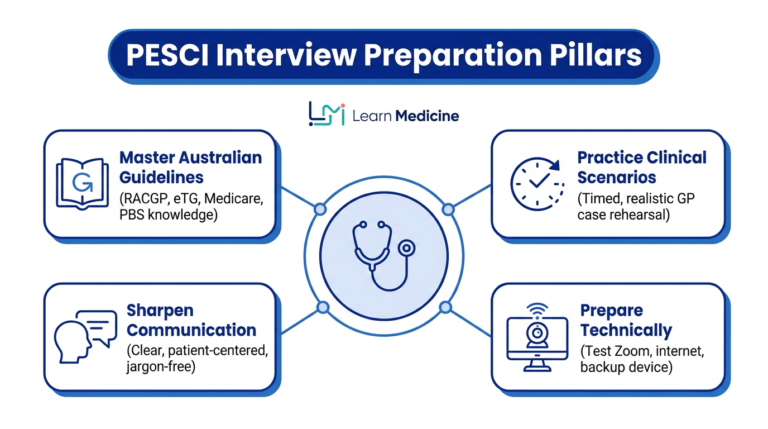
Start by confirming eligibility, your GP job offer, and the exact position description that IME will use. Next, study the eight domains and read up on the Australian healthcare system, including Medicare, local referral networks, and cultural safety guidance from the National Aboriginal Community Controlled Health Organization. Then move into repeated practice of GP‑style scenarios so that structured interviewing and reasoning feel natural on interview day.
A simple seven‑step IME PESCI preparation plan looks like this:
Clarify your scope and community. Read your position description carefully, noting patient groups, procedures, and on‑call work. Look up the local hospital, allied health services, and public health programs, so you can speak about realistic care pathways in that area.
Build system and guideline knowledge. Review Australian guidelines from groups like RACGP and Therapeutic Guidelines for common GP problems. Learn how Medicare item numbers, chronic disease care plans, and shared health summaries fit into everyday practice. According to the Australian Medical Association, GPs are expected to complete at least 50 hours of CPD each year, so staying current with guidelines aligns with long‑term practice.
Use structured communication frameworks. Practise history taking with tools such as SOCRATES for pain and AMPLE for emergency histories. Apply simple structures like ICE (ideas, concerns, expectations) and SPIKES for bad news. This helps you show the panel a clear, repeatable pattern instead of scattered questions.
Rehearse focused examinations and management plans. For each symptom group, outline which examinations you would perform in a typical GP room and which you would refer. Link your investigation and treatment choices to Australian resources and local services, explaining your safety‑netting advice each time.
Practise under exam conditions. Time your answers, speak aloud, and record yourself. Notice if you rush, miss red flags, or forget to explain follow‑up plans. Adjust and repeat.
Seek targeted feedback. Ask supervisors, colleagues, or experienced IMGs to act as mock panellists. Feedback on clarity, organisation, and cultural safety is especially valuable.
Refine your mindset and logistics. Confirm the interview format, test your internet connection and audio if online, and plan your travel if face‑to‑face. A calm, organised start reduces stress on the day.
At this point, working with a structured course often makes the difference between passive reading and active interview practice. LearnMedicine’s dedicated PESCI (IME) course offers 227 focused lectures across major GP domains, including cardiology, respiratory medicine, psychiatry, paediatrics, women’s health, and emergency presentations. Members also join four or more live role play sessions each week at 6:00 PM Melbourne or Sydney time, where tutors run mock PESCI panels and give direct feedback on your answers.
LearnMedicine’s all‑access membership model lets you combine PESCI and AMC Clinical preparation in one place, which matters because the AMC MCQ is a prerequisite for most IMGs. The platform includes more than 500 hours of video content, CPD Home certified modules, and a Telegram community for daily peer support. Membership also covers CV and cover letter review, which helps you secure the GP job offer you need before booking an IME PESCI.
To finish your plan, schedule at least two full‑length mock interviews, ideally with people who understand Australian general practice. Record yourself, reflect on timing, and adjust your explanations so they stay clear and patient‑friendly. By repeating this loop of study, practice, feedback, and refinement, you build the calm, systematic style that IME interviewers expect.
The Bottom Line

The IME PESCI is a focused assessment of your readiness for one supervised GP role, not a broad clinical exam. Your performance depends on applied reasoning, communication, and system knowledge more than on obscure facts. When you align your preparation with the eight domains and the real needs of your future practice, your answers sound safer and more confident.
Conclusion
If you treat the IME PESCI as a mystery, it will feel overwhelming and unfair. When you understand the eligibility rules, cost structure, interview format, and outcome process, it becomes another defined step in the Australian registration pathway. A structured preparation plan using real scenarios, clear frameworks, and feedback makes passing the interview far more realistic.
LearnMedicine offers IME PESCI candidates an integrated pathway that links AMC Clinical content, PESCI‑focused teaching, weekly role plays, and ongoing career support. By starting preparation early and working steadily through those resources, you can walk into your IME PESCI knowing what to expect and how to show the panel that you are ready to practise safely in Australian general practice.
Frequently Asked Questions
The following questions cover the practical details IMGs often search for after first hearing about the IME PESCI. Each answer is brief enough to guide quick decisions without reading the whole article.
How Long Is An IME PESCI Outcome Valid?
An IME PESCI outcome is usually valid for 12 months from the interview date. This means you need to line up your AHPRA application, practice start date, and any visa steps within that window. According to the Medical Board of Australia, a new PESCI may be required once that period expires or if the role changes significantly.
Can I Appeal An Unsuitable IME PESCI Outcome?
Yes, you can appeal an unsuitable IME PESCI outcome by submitting a written request within 14 days of receiving your report. IME charges a 1,000‑dollar administration fee for this process. A change of employment alone is not accepted as a reason, so it helps to address domain‑specific feedback before requesting a review or planning a resit.
Is The PESCI The Same As The AMC Clinical Examination?
No, the PESCI is not the same as the AMC Clinical Examination. The AMC Clinical checks broad medical competence across many settings, whereas the IME PESCI assesses readiness for one supervised GP role in Australia. Passing the AMC MCQ is normally required before the PESCI, and both assessments need different preparation strategies and practice formats.
How Many Times Can I Reschedule My IME PESCI?
You can reschedule your IME PESCI only once. The request must reach IME at least 28 days before the booked interview date and attracts a 500‑dollar administration fee. After that deadline, changes are treated under the cancellation policy, which can reduce or remove any refund.
Do I Need A Job Offer Before Applying For The IME PESCI?
Yes, a current Australian general practice job offer is a mandatory prerequisite for the IME PESCI. The practice must complete an IME position description template that describes supervision, patient mix, and procedures. IME uses this document to shape your interview questions and recommend whether you are suitable for that specific role.
 Google